
A literature review is one of the most important yet often misunderstood components of academic writing. Whether you are preparing a research paper, thesis, dissertation, or journal article, a well-crafted literature review demonstrates your understanding of the existing body of knowledge, identifies gaps, and positions your work within the broader scholarly conversation. For beginners, the process can feel overwhelming, but following a structured approach makes it manageable and rewarding.
This guide provides a clear, step-by-step framework to help novices write an effective literature review with confidence.
What Is a Literature Review?
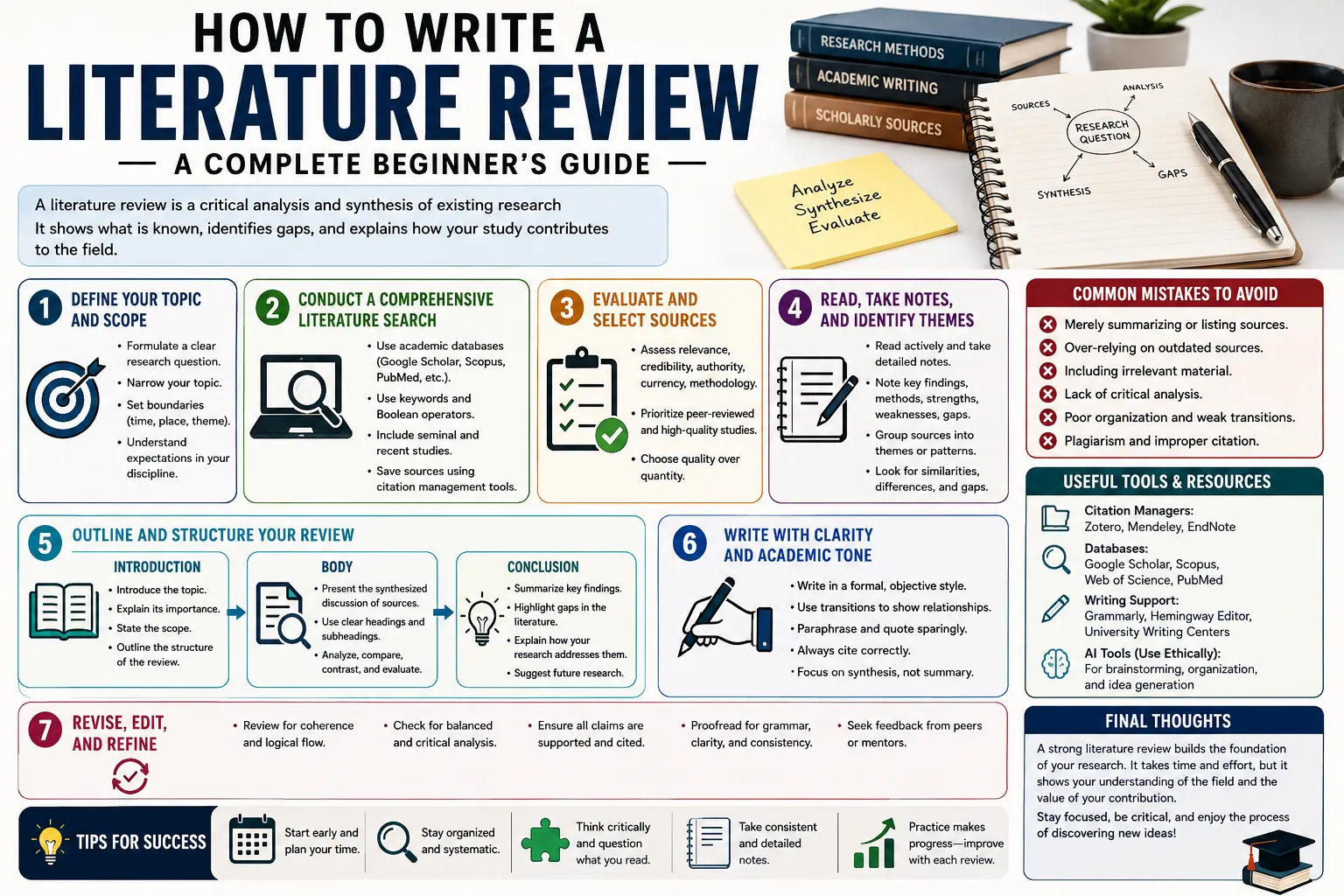
A literature review is not merely a summary of sources. It is a critical analysis and synthesis of scholarly works relevant to your research topic. It shows what is already known, highlights debates and contradictions, identifies gaps, and explains how your study contributes to the field. A strong review is organized, analytical, and directly linked to your research question.
Step 1: Define Your Research Topic and Scope
Begin by clearly defining your research question or topic. A focused question prevents the review from becoming too broad or scattered. For example, instead of “climate change,” narrow it to “the impact of climate change on coral reef ecosystems in the Indian Ocean.”
Set boundaries for your review: time period (e.g., publications from the last 10–15 years), geography, methodology, or specific themes. Understanding expectations in your discipline is essential — some fields favor chronological organization, while others prefer thematic or methodological approaches.
Step 2: Conduct a Comprehensive Literature Search
Search academic databases such as Google Scholar, PubMed, Scopus, Web of Science, or discipline-specific repositories. Use a combination of keywords, Boolean operators (AND, OR, NOT), and filters to refine results.
Start broad to get an overview, then narrow down. Include seminal (foundational) works as well as recent publications. Don’t forget grey literature such as theses, conference papers, and reports when relevant. Save all promising sources using a citation management tool like Zotero, Mendeley, or EndNote to organize references and avoid duplication.
Step 3: Evaluate and Select Sources
Not every source is worth including. Critically assess each for relevance, credibility, authority, currency, and methodology. Prioritize peer-reviewed journal articles, books by recognized experts, and high-impact studies.
Ask questions like: Does this source directly relate to my research question? What are its strengths and limitations? How does it connect to other works? Aim for quality over quantity — a focused review of 20–50 strong sources is often more effective than a lengthy but shallow one.
Step 4: Read, Take Notes, and Identify Themes
Read selected sources actively. Take detailed notes on key findings, methodologies, theoretical frameworks, strengths, weaknesses, and gaps. Group sources into themes, debates, or chronological developments rather than summarizing one by one.
Common organizational patterns include:
-
Thematic: Group by key concepts or topics.
-
Chronological: Show evolution of ideas over time.
-
Methodological: Compare different research approaches.
-
Theoretical: Discuss competing theories or frameworks.
Look for patterns, contradictions, agreements, and unanswered questions. This synthesis is what elevates your review from description to analysis.
Step 5: Outline and Structure Your Review
A typical literature review follows this structure:
-
Introduction: Define the topic, explain its importance, state the scope, and outline the organization of the review.
-
Body: Present the synthesized discussion of sources. Use clear headings and subheadings. Analyze rather than list — compare, contrast, and evaluate.
-
Conclusion: Summarize key findings, highlight gaps in the literature, and explain how your research addresses them. Suggest directions for future study.
Ensure smooth transitions between paragraphs and maintain a logical flow.
Step 6: Write with Clarity and Academic Tone
Write in a formal, objective style. Use transitional phrases to show relationships between sources (e.g., “Similarly,” “In contrast,” “Building upon this,”). Paraphrase most content and use direct quotes sparingly. Always cite sources properly using the required style (APA, MLA, Chicago, etc.).
Focus on synthesis: Show how different studies connect and contribute to understanding the topic. Avoid listing summaries like “Author A found X. Author B found Y.” Instead, integrate: “Studies by Author A and Author B both highlight X, though they differ in their explanation of Y.”
Step 7: Revise, Edit, and Refine
Set your draft aside for a few days before revising. Check for coherence, logical flow, balanced coverage, and critical depth. Ensure all claims are supported by evidence and properly cited. Proofread for grammar, clarity, and consistency. Consider asking a peer or mentor for feedback.
Common Mistakes to Avoid
-
Turning the review into a mere annotated bibliography or summary list.
-
Relying too heavily on older sources while ignoring recent developments.
-
Including irrelevant material or failing to stay focused on the research question.
-
Lack of critical analysis — simply describing without evaluating.
-
Poor organization and weak transitions.
-
Plagiarism through improper paraphrasing or citation.
Tools and Resources for Beginners
Citation managers, AI-assisted research tools (used ethically for brainstorming and organization), and university writing centers can provide valuable support. Start small if this is your first review — practice with a narrow topic before tackling larger projects.
Final Thoughts
Writing a literature review is a skill that improves with practice. It requires patience, critical thinking, and systematic effort, but the rewards are significant. A strong literature review not only strengthens your research foundation but also demonstrates your scholarly maturity and deep engagement with the field.
Beginners should remember that perfection is not the goal on the first attempt. Focus on learning the process, staying organized, and developing your analytical voice. Over time, you will gain confidence in synthesizing complex information and contributing meaningfully to academic conversations.
Whether for a class assignment, thesis, or publication, mastering the literature review is an essential step in your academic journey. Start early, stay focused, and approach the task as an opportunity to explore and understand rather than a mere requirement. With dedication and the right approach, even complete beginners can produce insightful, high-quality literature reviews.
