
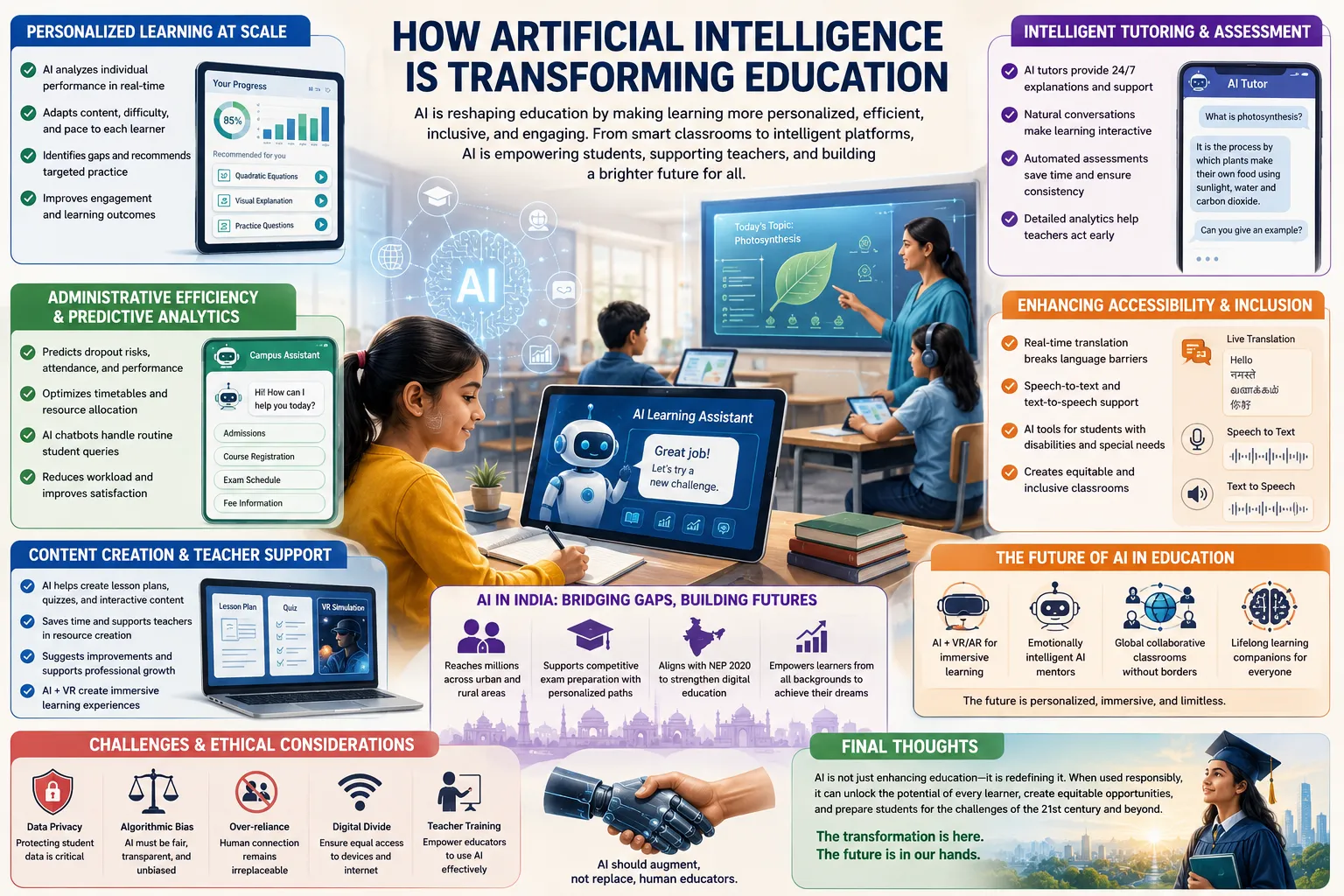
Artificial Intelligence is fundamentally reshaping education, moving it from a one-size-fits-all model to a more personalized, efficient, and inclusive system. In 2026, AI tools are no longer futuristic concepts but practical solutions integrated into classrooms, online platforms, and administrative systems worldwide. From adaptive learning experiences to automated administrative tasks, AI is enhancing both teaching and learning outcomes while addressing long-standing challenges in the education sector.
This transformation is particularly significant in diverse and resource-constrained environments like India, where AI offers scalable solutions to bridge gaps in access, quality, and personalization.
Personalized Learning at Scale
One of the most profound impacts of AI in education is personalized learning. Traditional classrooms often struggle to accommodate students with varying abilities, learning styles, and paces. AI-powered adaptive learning platforms analyze individual student performance in real-time and adjust content difficulty, pacing, and delivery methods accordingly.
These systems use machine learning algorithms to identify knowledge gaps and recommend targeted exercises. For instance, if a student struggles with quadratic equations, the platform might provide additional visual explanations, interactive simulations, or simpler foundational problems before advancing. This approach has shown measurable improvements in student engagement and retention rates. Studies indicate that students using adaptive platforms often achieve better learning outcomes compared to those in traditional settings.
In India, several edtech platforms leverage AI to offer personalized pathways for competitive exam preparation, helping millions of students from different socio-economic backgrounds receive tailored guidance.
Intelligent Tutoring and Assessment Systems
AI-powered intelligent tutoring systems (ITS) act as virtual mentors available 24/7. These systems can explain concepts, answer questions, and provide instant feedback much like a human tutor. Advanced large language models enable natural conversations, making learning more interactive and less intimidating.
Automated assessment is another game-changer. AI can grade essays, programming assignments, and complex problem sets with remarkable accuracy and consistency, freeing teachers from repetitive tasks. This allows educators to focus more on mentoring, creative instruction, and addressing individual student needs. AI also provides detailed analytics on student performance patterns, helping teachers identify class-wide misconceptions early.
Administrative Efficiency and Predictive Analytics
Schools and universities are using AI to streamline administrative burdens. Predictive analytics tools forecast student dropout risks, attendance patterns, and academic performance, enabling timely interventions. AI assists in timetable optimization, resource allocation, and even campus security through smart surveillance systems.
In higher education, AI-powered chatbots handle routine student queries about admissions, course registrations, and deadlines, significantly reducing administrative workload. This efficiency translates into cost savings and improved student satisfaction.
Enhancing Accessibility and Inclusion
AI is making education more accessible than ever before. Real-time translation tools break language barriers, allowing students to learn in their preferred language. Speech-to-text and text-to-speech technologies support students with visual or hearing impairments. AI can generate simplified explanations, audio descriptions, or sign language interpretations, promoting inclusive education.
For students with learning disabilities such as dyslexia or ADHD, AI tools offer customized support through gamified learning, focus-enhancing interfaces, and adaptive reading assistants. This levels the playing field and helps create more equitable learning environments.
Content Creation and Teacher Support
AI is transforming how educational content is created and delivered. Teachers can use generative AI to develop lesson plans, quizzes, interactive simulations, and multimedia resources quickly. This is particularly valuable in regions facing teacher shortages.
AI also supports continuous professional development for educators by analyzing teaching patterns and suggesting improvement strategies. Virtual reality combined with AI creates immersive learning experiences, such as virtual science labs or historical recreations, making abstract concepts tangible.
Challenges and Ethical Considerations
Despite its promise, AI in education comes with important challenges. Data privacy remains a major concern, as student information is highly sensitive. There is also the risk of algorithmic bias, where AI systems might perpetuate existing inequalities if trained on skewed data.
Over-reliance on AI could potentially reduce human interaction, which is crucial for social and emotional development. The digital divide — unequal access to devices and high-speed internet — risks leaving behind students from underprivileged backgrounds.
Ethical guidelines, robust data protection frameworks, and teacher training are essential to ensure AI augments rather than replaces human educators. A balanced approach that combines technological efficiency with human empathy is key to successful implementation.
The Future of AI in Education
Looking ahead, the integration of AI with other emerging technologies like virtual reality, augmented reality, and brain-computer interfaces promises even more revolutionary changes. We may see highly sophisticated AI mentors capable of emotional intelligence, lifelong learning companions, and truly global collaborative classrooms.
In India, the National Education Policy 2020 has recognized technology’s role, paving the way for greater AI adoption in both public and private education sectors. As infrastructure improves and digital literacy grows, AI has the potential to democratize quality education across the country.
Final Thoughts
Artificial Intelligence is not merely enhancing education — it is redefining it. By enabling personalization at scale, reducing administrative burdens, improving accessibility, and providing powerful analytical insights, AI helps create more effective, engaging, and equitable learning environments.
However, technology alone cannot solve all educational challenges. The most successful implementations will be those that keep human teachers and students at the center, using AI as a supportive tool rather than a replacement.
As we move further into this AI-driven era, the focus must remain on thoughtful integration, ethical deployment, and continuous evaluation. When implemented responsibly, artificial intelligence has the power to unlock the full potential of every learner, preparing them better for the complexities of the 21st century and beyond.
The transformation is already underway. The question is no longer whether AI will change education, but how thoughtfully we guide that change to benefit all students.
