
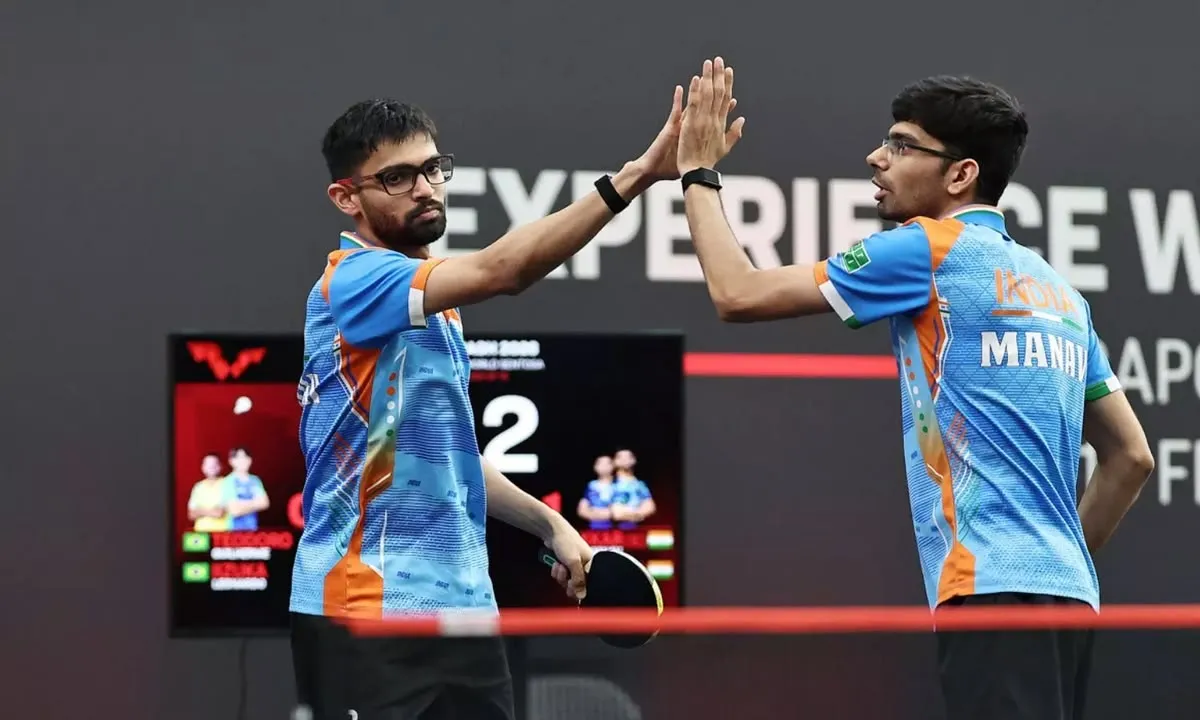
In the fast-evolving landscape of Indian table tennis, few partnerships have risen as steadily or as purposefully as that of Manav Thakkar and Manush Shah. The Gujarat duo, ranked among the world’s top three in men’s doubles, heads into the Asian Games in Aichi-Nagoya as India’s strongest podium prospect in the sport. Their left-right combination, years of shared understanding, and growing maturity on the international circuit have turned a natural friendship into a formidable competitive force.
A Partnership Built on Friendship and Complementarity
Manav Thakkar and Manush Shah have known each other for roughly a decade. Both products of Gujarat’s table tennis ecosystem, they moved in similar junior circuits before deciding to formalise their doubles partnership at the senior level around 2022-23. What began almost casually quickly showed promise. In one of their earliest senior tournaments together, they reached the semi-finals of a WTT Contender event. Their second major outing produced an even clearer statement of potential: a quarter-final appearance at the 2023 Hangzhou Asian Games.
That Hangzhou campaign remains a defining reference point. Facing the then world No. 1 Korean pair, the Indians pushed the contest to the limit and held match points before falling short. The narrow defeat still lingers in their conversations. Both players have spoken of the unresolved feeling from that match and the determination to convert similar opportunities when they arise again. The experience, however, also confirmed that they belonged at the highest level.
The Advantage of Left and Right
One of the clearest technical strengths of the pair is the classic left-hander and right-hander combination. Manush Shah is left-handed; Manav Thakkar is right-handed. In doubles, this configuration creates natural angles, disrupts opponents’ rhythm, and allows for complementary coverage of the table. Manav has noted that once he experienced the advantages of partnering a left-hander, combining with another right-hander, even in mixed doubles, began to feel less natural.
Beyond the handedness advantage, the two players bring contrasting yet compatible styles. Manush is widely regarded as the more aggressive, attacking presence. Manav often operates as a counter-attacker, retrieving and redirecting with control. Over the past year they have deliberately worked on defensive organisation, footwork coordination and the ability to complement each other under pressure. The result is a pairing that can both dictate points and absorb pressure when required.
Climbing the World Rankings
The partnership’s progress on the World Table Tennis circuit has been steady and significant. Strong results, including a title at the WTT Contender Lagos and deep runs at major Smash events—most notably a historic semi-final appearance at the Singapore Smash—propelled them up the rankings. They became the first Indian men’s doubles pair to reach world No. 2, later settling at No. 3 in the lead-up to the Asian Games. That ranking places them among the global elite and secures a favourable seeding at the continental championships.
Their rise also reflects broader improvement in Indian doubles tennis. For the first time, Indian pairs have simultaneously featured in the higher echelons of men’s, women’s and mixed doubles rankings, signalling a more competitive depth than the sport has traditionally enjoyed.
More Than Doubles Specialists
Both players remain important figures in India’s singles and team setups. Manav Thakkar has frequently been India’s highest-ranked men’s singles player in recent cycles, while Manush Shah has also maintained a strong singles presence. Their ability to contribute across formats adds value to the national team and keeps their individual games sharp. Playing high-level singles helps maintain the intensity and tactical awareness they bring to doubles.
At the Asian Games they are expected to feature in singles, doubles and the team event, with Manush also scheduled for mixed doubles. The multi-event load will test their physical and mental management, yet it also offers multiple pathways to contribute to India’s medal tally.
Expectations and Perspective
Heading into Aichi-Nagoya, expectations around the pair are higher than they were in Hangzhou. Then they were relative underdogs. Now they arrive as one of the higher-seeded combinations and as India’s clearest medal hope in table tennis. Both players have acknowledged the shift. They speak of the opportunity and the responsibility, while emphasising the need to stay process-oriented and enjoy the competition.
The memory of the 2023 quarter-final loss continues to serve as both motivation and caution. They know how fine the margins can be against the continent’s best pairs, particularly those from China, Japan and Korea. Improved ranking, greater experience and deliberate work on their combination give them reason for belief. Translating that belief into a medal will require peak execution across several high-pressure matches.
A Broader Signal for Indian Table Tennis
The emergence of Manav and Manush as a consistent world-class doubles pair carries significance beyond one event. For years Indian table tennis relied heavily on occasional singles breakthroughs or team performances. Sustained excellence in doubles, especially at the highest ranking levels, points to improving systems of pairing, training and international exposure. Their success also offers a template: long-term understanding between partners, technical complementarity, and the willingness to treat doubles as a specialised craft rather than a secondary event.
As they prepare to take on Asia’s strongest combinations, Manav Thakkar and Manush Shah represent both continuity and progress. Continuity, because they carry forward the competitive spirit shown in Hangzhou. Progress, because they now do so from a position of proven world ranking and refined partnership. The left-right combination that once felt like a natural experiment has become one of Indian table tennis’s most reliable assets. The Asian Games will test how far that asset can travel on the biggest continental stage.
Read more – SmallBizSeo.org
