
In a striking contrast to its image as a sacred hub of ancient temples and exquisite silk weaving, Kancheepuram in Tamil Nadu has once again claimed the top position in India’s infidelity rankings. According to Ashley Madison’s latest data for May 2026, the city recorded the highest number of sign-ups on the discreet dating platform designed for married individuals seeking extramarital connections. This marks the second consecutive period of dominance for the temple town, underscoring a broader transformation in attitudes toward marriage, monogamy, and personal desires across urban and semi-urban India.
Kancheepuram, often called the “City of Thousand Temples,” has long symbolized spiritual heritage, architectural grandeur, and traditional craftsmanship. Famous for its handwoven Kanchipuram silk sarees—prized for their durability, intricate zari work, and cultural significance in South Indian weddings—the city draws pilgrims and tourists alike. With a population of approximately 200,000, it sits about 70 kilometers from Chennai, blending historical piety with everyday life. Yet, this latest ranking paints a more complex portrait of contemporary realities, where private yearnings challenge public facades of tradition.
The Data Behind the Ranking
Ashley Madison’s metrics, based on new user registrations and engagement levels, highlight Kancheepuram’s consistent lead. The city’s surge began noticeably in 2025, when it dramatically climbed from 17th place to the number one spot nationally. In May 2026, it retained this position, outpacing major metropolitan areas. Other Tamil Nadu cities like Coimbatore, Tiruvallur, and Chennai also feature prominently in regional tallies, suggesting a South Indian trend.
Delhi-NCR dominates many of the top 20 positions, with districts such as Central Delhi, Gurgaon, and Noida showing strong activity. Interestingly, Mumbai often fails to crack the top 20, indicating that infidelity interest is not confined to or defined by India’s largest metros. Tier-2 and tier-3 locations are increasingly driving growth, reflecting wider digital access and evolving mindsets beyond traditional urban centers.
Unpacking the Paradox: Tradition Meets Modernity
Why would a culturally conservative temple town lead in discreet relationship sign-ups? Experts point to several intersecting factors. Improved internet penetration and smartphone affordability have democratized access to global platforms, even in smaller cities. What was once limited to cosmopolitan elites is now within reach for professionals, business owners, and middle-class families in places like Kancheepuram.
Rapid socio-economic changes play a role. Tamil Nadu has seen significant urbanization, industrialization, and migration patterns that strain traditional joint family structures. Longer work hours, nuclear households, and exposure to diverse lifestyles through social media and streaming content contribute to shifting expectations around marriage. While arranged marriages and strong familial bonds remain prevalent, individuals—particularly in the 30-50 age group—may seek emotional or physical fulfillment outside conventional boundaries when domestic routines feel unfulfilling.
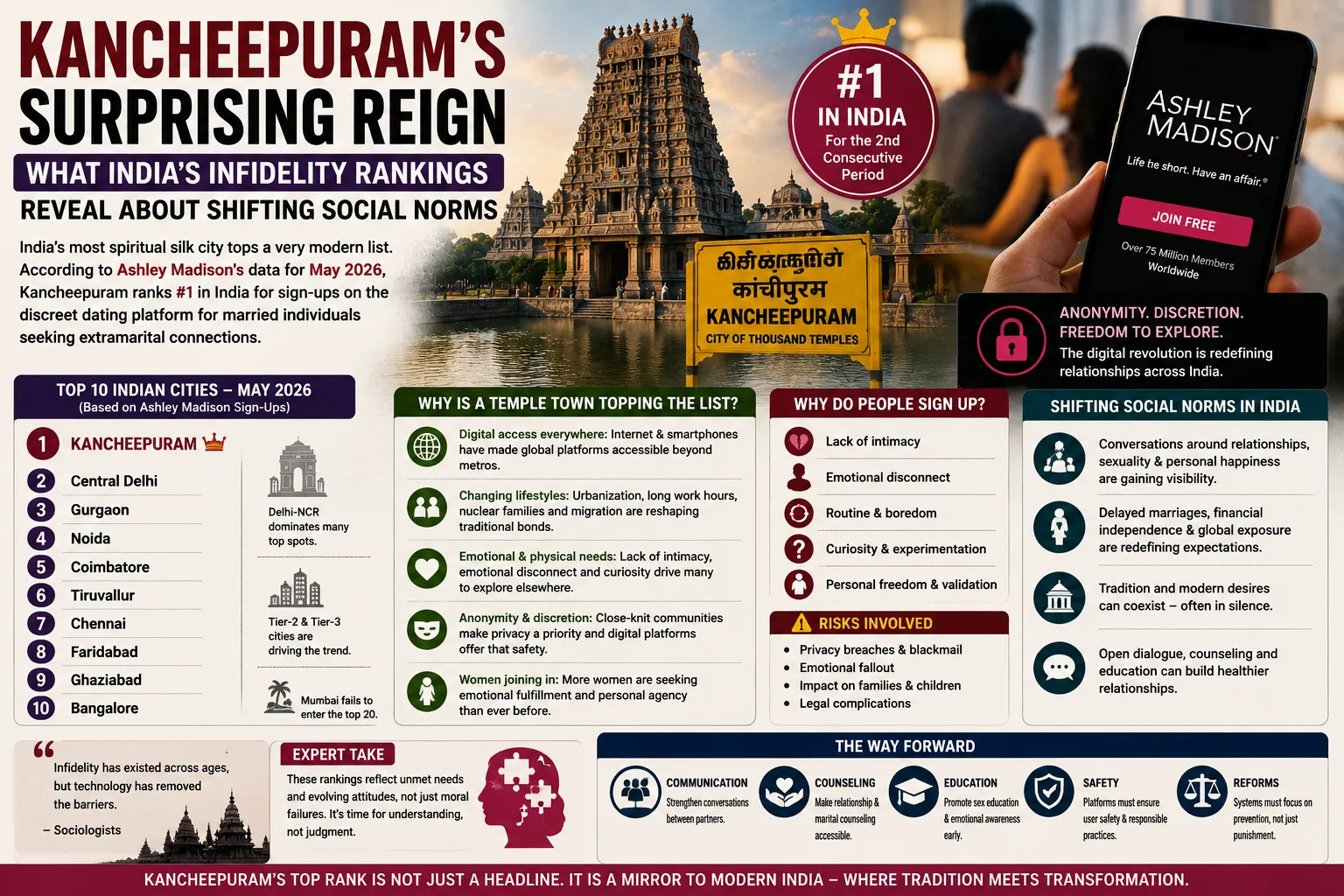
The platform’s appeal lies in its promise of anonymity and discretion, features that resonate in close-knit communities where social judgment remains harsh. In a society where divorce still carries stigma in many circles, extramarital exploration offers an outlet without immediate disruption to family stability. Ashley Madison’s growth in India, which has climbed rapidly in global rankings, mirrors this tension between collective values and individual autonomy.
Broader Trends in Indian Relationships
This phenomenon is not isolated. Nationwide, conversations around non-monogamy, emotional needs, and satisfaction are gaining visibility. Factors such as delayed marriages, financial independence for women, and post-pandemic reflections on life priorities have accelerated change. Surveys and anecdotal evidence suggest many users cite reasons like lack of intimacy, emotional disconnect, or curiosity as motivations—universal drivers amplified by digital ease.
Gender dynamics are evolving too. While men have historically dominated such platforms, increasing female participation signals greater agency. Women in smaller towns, balancing careers or homemaking with societal expectations, may find discreet options empowering rather than taboo. However, this comes with risks: data privacy concerns, potential blackmail, and emotional fallout remain significant.
Critics argue that rankings like these sensationalize private behavior and overlook deeper issues such as marital counseling access, mental health support, and unequal domestic loads. Defenders see them as neutral indicators of unmet needs in modern relationships, highlighting the need for open dialogue rather than moral panic.
Cultural and Social Implications
Kancheepuram’s story challenges stereotypes. Far from being immune to global influences, traditional centers are often at the forefront of subtle transformations. The same community that reveres ancient temples and weaves symbolic sarees for life’s milestones is navigating contemporary desires. This duality reflects India’s larger transition: a nation rooted in heritage yet propelled by economic liberalization, technology, and globalization.
Sociologists note that infidelity has existed across eras and cultures, but its visibility has surged with technology. Platforms reduce barriers—geographic, social, and logistical—making exploration more feasible. In conservative settings, this can create cognitive dissonance, where public piety coexists with private experimentation. Families and religious institutions may need to adapt by fostering communication and addressing root causes like compatibility and evolving gender roles.
Looking Ahead: Challenges and Opportunities
The persistence of Kancheepuram at the top suggests the trend is not fleeting. As digital literacy spreads and stigma slowly erodes, more tier-2 cities could follow. This raises important questions for policymakers, educators, and relationship experts: How can society support healthier marriages while respecting personal freedoms? Greater investment in premarital counseling, accessible therapy, and sexeducation could mitigate some pressures.
On the platform side, responsible practices around verification and safety are crucial to prevent exploitation. For individuals, awareness of emotional and legal consequences remains vital. Ultimately, these rankings serve as a mirror to societal evolution rather than a definitive judgment.
Kancheepuram’s dual identity—as a custodian of spiritual and artisanal legacy and now a surprising leader in discreet connections—encapsulates modern India’s complexities. It reminds us that beneath layered traditions lie human universals: the search for connection, fulfillment, and understanding. As attitudes continue to shift, open, non-judgmental conversations will be key to navigating these changes constructively, ensuring that both cultural heritage and individual well-being can coexist.
The city’s repeated top ranking is more than a data point; it is an invitation to reflect on how India’s diverse communities are redefining relationships in the 21st century—one discreet click at a time.
