
For decades, rare earth minerals have played a crucial role in modern technology, powering everything from electric vehicles and renewable energy systems to smartphones and advanced industrial machines. Among these minerals, rare earth elements used in permanent magnets have become especially important because they allow electric motors to become smaller, lighter, and more efficient.
However, the global supply chain for rare earth materials is heavily concentrated, with China controlling a significant share of rare earth mining, processing, and magnet production. This dependence has created challenges for countries looking to expand electric mobility and clean energy technologies without relying on a single dominant supplier.
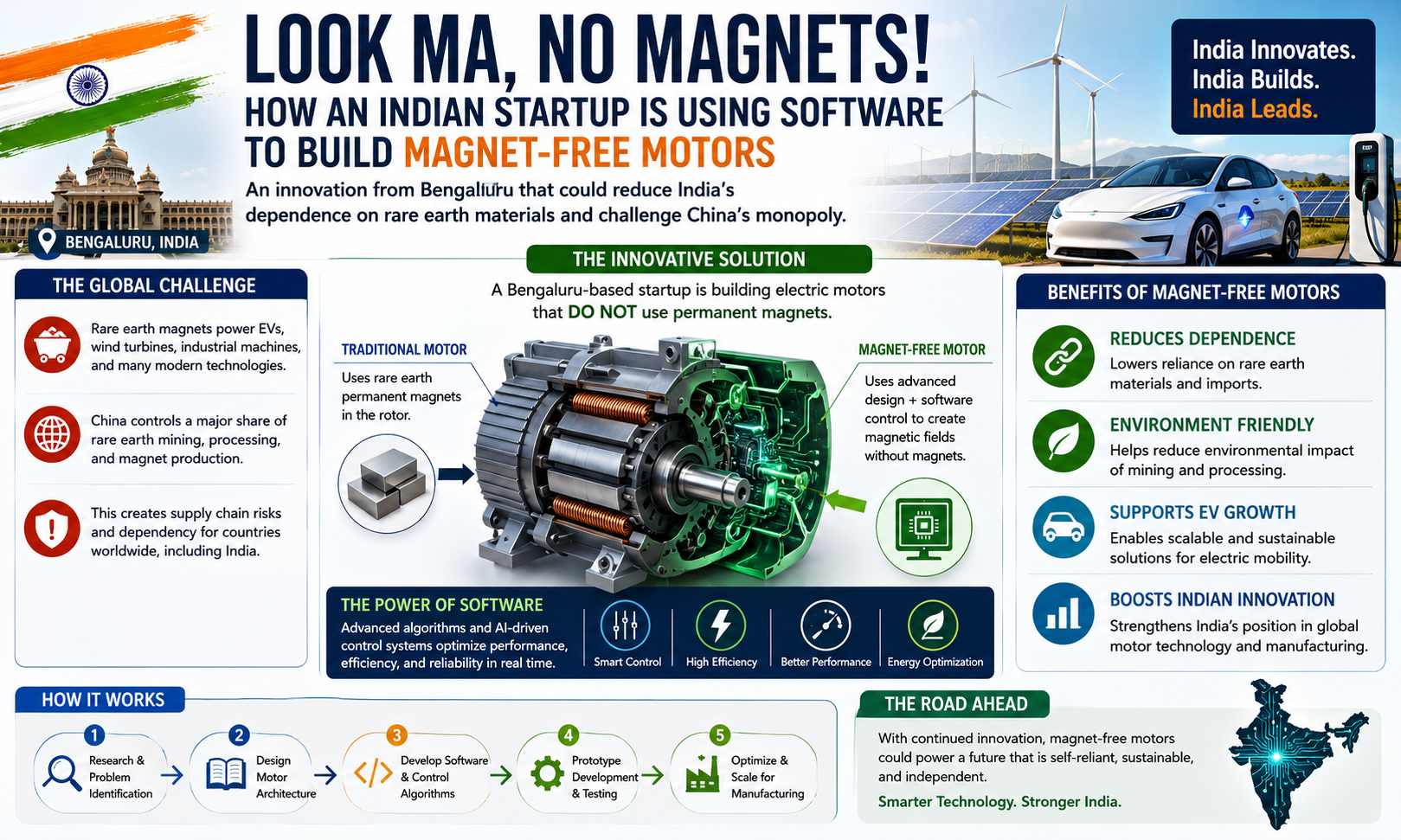
In response to this challenge, an Indian startup based in Bengaluru is developing a new approach: creating electric motors that do not depend on permanent magnets. Instead of using rare earth-based magnets, the company is using advanced software, engineering innovation, and intelligent motor control systems to design efficient magnet-free motors.
This technology could become an important step toward reducing dependence on rare earth materials and strengthening India’s position in the global electric motor industry.
The Importance of Rare Earth Magnets in Modern Technology
Rare earth magnets are among the strongest permanent magnets available today. They are commonly made using materials such as neodymium, iron, and boron. These magnets provide powerful magnetic fields while maintaining a compact size, making them highly valuable for modern engineering applications.
Electric vehicle motors, wind turbines, industrial machines, robotics, and many electronic devices depend on these magnets because they improve performance and efficiency.
The growing demand for electric vehicles has further increased the importance of rare earth magnets. Electric motors require powerful and reliable components, and permanent magnet motors have traditionally been considered one of the best solutions.
However, the limited availability and concentrated supply chain of rare earth materials have raised concerns for manufacturers worldwide.
China’s Dominance Over Rare Earth Supply Chains
China has established a strong position in the global rare earth industry. The country has significant capabilities in rare earth mining, refining, processing, and manufacturing permanent magnets.
While rare earth elements are found in different parts of the world, processing these materials requires advanced technology and infrastructure. China’s long-term investment in this sector has allowed it to become a major supplier of rare earth products globally.
This dominance has created supply chain concerns for countries that depend on imported rare earth materials for industries such as electric vehicles, renewable energy, and electronics.
As nations work toward cleaner transportation and energy solutions, reducing dependence on limited resources has become a major technological goal.
The Indian Startup’s Innovative Approach
A Bengaluru-based startup is attempting to solve this challenge by developing electric motors that do not require permanent magnets. Instead of relying on rare earth materials, the company is focusing on software-driven motor technology.
The idea behind this innovation is simple but challenging: if motors can be designed without permanent magnets, manufacturers can reduce dependence on rare earth elements while creating more sustainable and reliable systems.
The startup is using advanced algorithms, motor design techniques, and software-based control systems to improve motor performance. By replacing some of the advantages traditionally provided by permanent magnets through intelligent engineering, the company aims to create efficient alternatives.
This approach represents a shift from relying only on physical materials toward combining hardware innovation with software intelligence.
How Magnet-Free Motors Work
Traditional permanent magnet motors use magnets attached to the rotor to generate movement. These magnets create a strong magnetic field that helps convert electrical energy into mechanical motion efficiently.
Magnet-free motors use different designs that generate magnetic fields without permanent magnets. These systems may rely on technologies such as switched reluctance motors, induction-based designs, or electrically controlled magnetic fields.
The major challenge with these designs is improving efficiency, reducing noise, and achieving performance levels comparable to permanent magnet motors.
Software plays an important role in solving these challenges. Advanced control systems can optimize motor operation, improve energy usage, and enhance overall performance.
By using intelligent software, engineers can make magnet-free motors more competitive for applications where permanent magnet motors have traditionally dominated.
Role of Software in Next-Generation Motor Technology
The development of modern motors is no longer limited to mechanical engineering. Software has become an essential part of improving efficiency and performance.
Artificial intelligence, machine learning algorithms, and advanced control systems can analyze motor behavior and adjust operations in real time.
For example, software can help manage:
Motor speed control
Energy consumption
Heat management
Performance optimization
Power efficiency
These improvements allow companies to design motors that perform better without depending heavily on expensive or limited materials.
The Bengaluru startup’s approach highlights how software innovation can influence hardware development and create new solutions for global industrial challenges.
Benefits of Developing Magnet-Free Motors
The development of motors without permanent magnets offers several potential advantages.
Reducing Dependence on Rare Earth Materials
The biggest advantage is reducing reliance on rare earth minerals. Countries and companies can create electric motors without depending entirely on imported magnet materials.
This can improve supply chain security and reduce vulnerability to global market disruptions.
Supporting Electric Vehicle Growth
Electric vehicles are expected to play a major role in future transportation. However, increasing EV production requires a stable supply of essential components.
Magnet-free motors could provide an alternative solution for EV manufacturers looking for more sustainable technologies.
Lower Environmental Impact
Rare earth mining and processing can create environmental challenges. Reducing the use of rare earth materials may help decrease the environmental impact associated with mining and refining activities.
Encouraging Indian Technology Innovation
The development of advanced motor technology within India can strengthen domestic manufacturing capabilities and encourage innovation in clean technology sectors.
Challenges Facing Magnet-Free Motor Technology
Although magnet-free motors offer promising benefits, several challenges remain.
One major challenge is achieving the same efficiency and power density as permanent magnet motors. Rare earth magnets provide exceptional performance, and replacing them requires advanced engineering solutions.
Another challenge is increasing production capacity. Developing a successful prototype is only the first step; large-scale manufacturing requires investment, infrastructure, and industry partnerships.
Cost competitiveness is also important. New technologies must eventually become affordable enough for widespread adoption across industries.
Despite these challenges, continued research and innovation could help overcome these limitations.
India’s Growing Focus on Technology Independence
India has been increasingly focusing on developing domestic capabilities in critical technologies, including renewable energy, electric vehicles, semiconductor manufacturing, and advanced engineering.
Reducing dependence on imported materials and technologies has become an important goal for strengthening economic and industrial security.
Innovations such as magnet-free motors demonstrate how Indian startups can contribute to solving global problems through engineering creativity and technology development.
Future Possibilities of Magnet-Free Motors
As electric mobility and renewable energy continue to expand, demand for efficient motor technologies will keep increasing.
Magnet-free motors could become an important alternative in areas where reducing material dependency is a priority. With improvements in software, artificial intelligence, and manufacturing techniques, these motors may become more efficient and commercially viable.
The Bengaluru startup’s work represents a broader trend in technology: using innovation to overcome resource limitations.
Instead of competing only through access to rare materials, future industries may increasingly compete through smarter designs, better software, and engineering breakthroughs.
Conclusion
The development of magnet-free motors by an Indian startup represents an innovative attempt to address one of the biggest challenges in modern technology: dependence on rare earth materials.
By combining software intelligence with advanced motor engineering, the company is exploring a future where powerful electric motors can be created without relying on permanent magnets.
While challenges remain in efficiency, scalability, and cost, this technology highlights the potential of Indian innovation in solving global industrial problems. As the world moves toward electric transportation and clean energy, alternatives to rare earth-dependent technologies could become increasingly important for building a more balanced and sustainable technology ecosystem.