
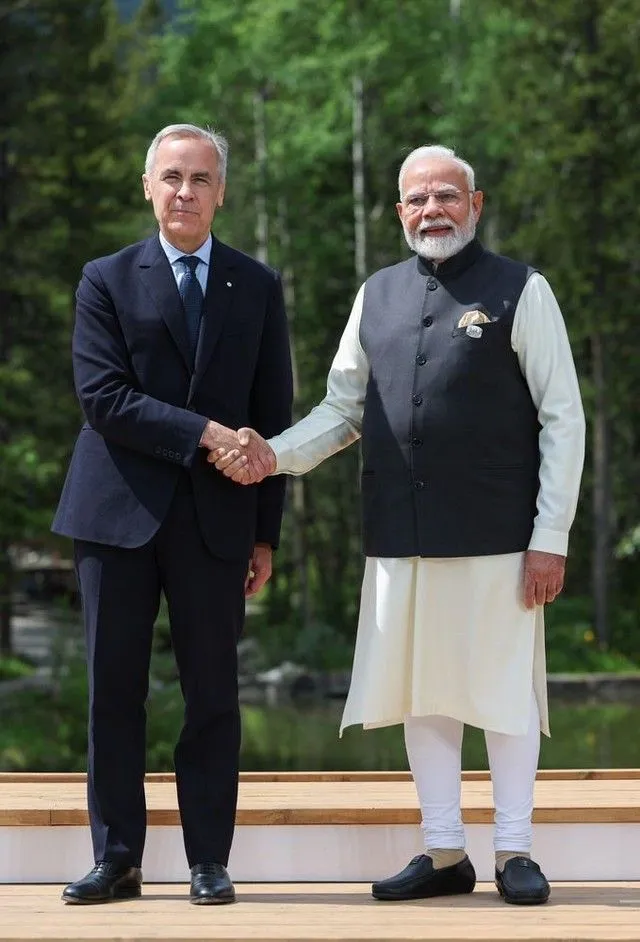
Canadian Prime Minister Mark Carney has said that trade negotiations with India are making good progress and that both countries are working to conclude the talks by the G20 summit in mid-December. Speaking on the sidelines of the United Nations General Assembly, Carney also indicated that Indian Prime Minister Narendra Modi is expected to visit Canada around the same period, though a precise date has yet to be finalised.
Commitment at the Highest Level
Carney stated that he and Modi had committed to trying to wrap up the negotiations by the G20. The summit is scheduled for 14-15 December. The Canadian leader described the relationship with India as exceptionally important across people-to-people ties, security cooperation and economic engagement.
The remarks underscore a clear political intention on both sides to convert the ongoing talks into a tangible agreement within a defined timeframe. Setting the G20 as a target provides negotiators with a high-profile deadline and creates an opportunity for leaders to announce progress during a major international gathering.
Background to the Negotiations
Canada and India formally launched negotiations on a comprehensive trade agreement in March 2026. Both governments had already indicated their aim to conclude the discussions by the end of the year. The latest comments from Carney suggest that the process remains on track and that momentum has been maintained through successive rounds of talks.
A successful agreement would cover a broad range of areas, including goods, services, investment, agriculture and other sectors of mutual interest. For Canada, deeper commercial ties with India form part of a larger strategy to diversify trade and reduce reliance on the United States. Carney has spoken of doubling Canada’s non-US trade over the next decade, and India is viewed as a significant partner in that effort.
Diplomatic Context
The current phase of economic engagement follows a difficult period in bilateral relations. Ties between Ottawa and New Delhi deteriorated sharply after the 2023 killing of Canadian Sikh activist Hardeep Singh Nijjar in British Columbia, an episode that led to a prolonged diplomatic freeze. The decision to restart and accelerate trade negotiations reflects a deliberate attempt by both governments to stabilise and expand the relationship despite unresolved political sensitivities.
Carney’s government has treated the rebuilding of ties with India as a priority. The Canadian Prime Minister has previously visited India, and the prospect of a reciprocal visit by Modi around the G20 window would represent a further step in the normalisation of high-level contact.
Strategic and Economic Stakes
India’s large and growing market offers Canadian exporters opportunities in sectors ranging from agriculture and agri-food to education, energy and technology. Canada, for its part, remains an attractive destination for Indian investment and a source of critical resources and educational partnerships. A comprehensive trade agreement would lower barriers, improve predictability and encourage businesses on both sides to expand their engagement.
At the same time, negotiators must navigate sensitive issues, including agricultural market access, mobility of professionals and the protection of intellectual property. The ability to resolve these questions in time for a G20-related announcement will test the political will and technical flexibility of both sides.
Timing and Next Steps
The coming weeks will be critical. With the G20 deadline now publicly affirmed, officials in Ottawa and New Delhi will need to intensify their work. Parallel preparations for a possible Modi visit to Canada would add a political dimension to the commercial timetable, creating incentives to demonstrate concrete results.
Carney’s comments also serve a domestic purpose. By highlighting progress with India, he reinforces the narrative that Canada is actively pursuing new markets at a time of uncertainty in its traditional trading relationship with the United States. For the Indian government, advancing the talks aligns with its broader strategy of expanding economic partnerships across different regions.
Broader Implications
A concluded trade agreement by December would mark one of the more significant recent successes in India’s expanding network of economic partnerships and would give Canada a notable achievement in its diversification agenda. Even if final legal scrubbing and ratification extend beyond the G20, a political understanding or announcement of substantial conclusion would itself carry weight.
The process also illustrates how economic interests can help stabilise relationships that have experienced political strain. While differences over security and diaspora-related issues have not disappeared, both capitals appear prepared to compartmentalise those disagreements sufficiently to pursue mutual commercial gains.
Looking Ahead
Mark Carney’s statement provides the clearest public indication yet that Canada and India intend to bring their trade negotiations to a decisive stage before the end of the year. The combination of a leadership-level commitment, an external deadline in the form of the G20, and the prospect of a Modi visit to Canada creates a favourable political backdrop for negotiators.
Whether the talks conclude in full by mid-December will depend on the resolution of remaining sticking points. What is already evident is that both governments have invested significant political capital in the effort. For businesses and observers in both countries, the coming months will reveal whether that investment produces a durable new framework for economic relations.
Read more – slangpilot.com
