
Ghost stories have fascinated humanity for centuries. From haunted houses and abandoned buildings to mysterious sounds in the dead of night, tales of paranormal activity continue to capture public imagination across cultures and generations. In India, where folklore, spirituality, and supernatural beliefs are deeply woven into social traditions, reports of hauntings and unexplained phenomena remain common.
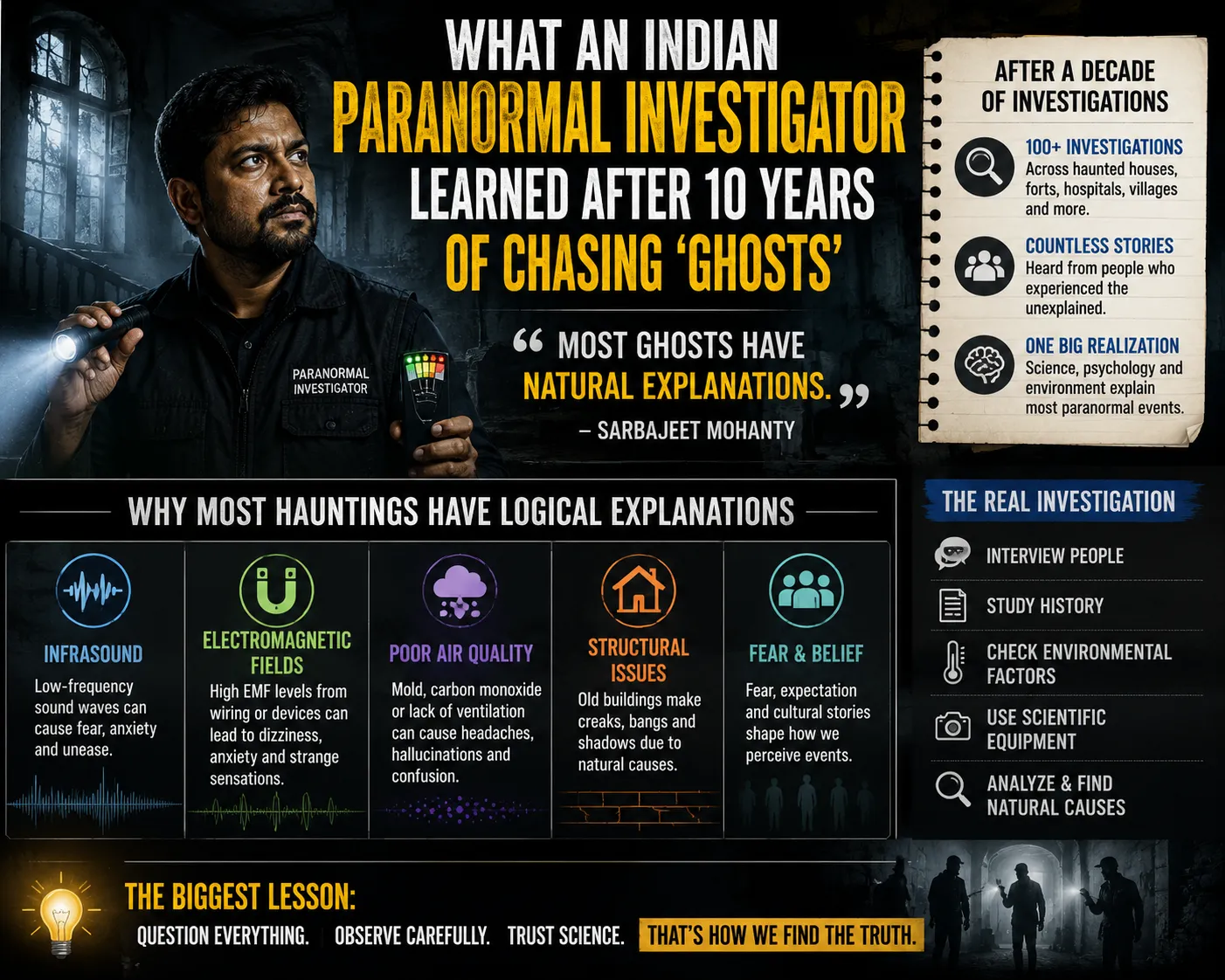
However, after spending more than a decade investigating alleged paranormal incidents, Indian paranormal investigator Sarbajeet Mohanty has reached a conclusion that may surprise many believers: most so-called ghost sightings and hauntings have natural explanations.
According to Mohanty, fear, misinformation, environmental factors, and psychological influences often create experiences that people interpret as supernatural. Through scientific investigation and evidence-based analysis, his team has examined numerous cases that initially appeared mysterious but were ultimately explained through logical reasoning and careful observation.
His experiences offer valuable insights into how humans perceive the unknown and why paranormal stories continue to persist despite advances in science and technology.
The Growing Interest in Paranormal Investigations
Paranormal investigation has become increasingly popular in recent years, fueled by television shows, online content, social media discussions, and public fascination with unexplained events.
Reports of haunted locations, strange apparitions, mysterious sounds, and supernatural encounters often attract significant attention. In many cases, individuals experiencing unusual events genuinely believe they are witnessing paranormal activity.
This is where investigators like Sarbajeet Mohanty step in.
Rather than accepting supernatural explanations immediately, professional paranormal investigators attempt to evaluate claims using scientific methods, environmental testing, interviews, and data collection.
The objective is not necessarily to prove or disprove the existence of ghosts but to examine whether reported experiences can be explained through measurable and observable factors.
How Paranormal Claims Are Investigated
Contrary to popular belief, modern paranormal investigations often resemble scientific field studies more than ghost-hunting adventures.
When a haunting claim is reported, investigators typically begin by gathering detailed information from witnesses.
This process includes:
- Interviewing residents or witnesses
- Examining the history of the location
- Reviewing environmental conditions
- Documenting reported incidents
- Identifying patterns in experiences
Investigators may also use specialized equipment to measure environmental factors such as temperature fluctuations, electromagnetic fields, air quality, humidity, and sound frequencies.
The goal is to determine whether natural conditions could be responsible for the reported experiences.
In many cases, seemingly paranormal events turn out to have surprisingly ordinary explanations.
The Role of Fear in Creating Ghost Stories
One of the most important lessons Mohanty says he has learned is the powerful influence of fear.
Human beings are naturally inclined to seek explanations for unfamiliar experiences. When people encounter unusual sounds, shadows, or sensations in unfamiliar environments, fear can shape how those experiences are interpreted.
For example, a creaking floorboard in an old building may seem insignificant during daylight hours but can appear frightening late at night when expectations and emotions are different.
Psychologists have long recognized that fear affects perception. When individuals already believe a location is haunted, they may become more sensitive to ordinary events and interpret them as evidence of supernatural activity.
This phenomenon is often referred to as expectation bias.
Once a person expects to encounter paranormal activity, the brain may begin connecting unrelated events into a narrative that reinforces that belief.
Environmental Factors Often Explain “Hauntings”
Many reported hauntings involve environmental conditions that can influence human perception.
Infrasound
Certain low-frequency sound waves, known as infrasound, are below the threshold of normal human hearing. Although people may not consciously hear these sounds, they can create feelings of discomfort, anxiety, or unease.
Some studies have suggested that infrasound may contribute to sensations commonly associated with haunted locations.
Electromagnetic Fields
Abnormal electromagnetic field (EMF) exposure has also been investigated as a potential factor in paranormal experiences.
High EMF levels generated by faulty wiring or electrical equipment may contribute to feelings of dizziness, anxiety, and unusual sensory experiences in some individuals.
Poor Air Quality
Carbon monoxide leaks, mold exposure, and inadequate ventilation can cause symptoms such as headaches, confusion, hallucinations, and disorientation.
In several well-documented cases worldwide, alleged hauntings were ultimately traced to environmental hazards affecting occupants’ health.
Structural Issues
Old buildings often produce unusual sounds due to settling foundations, temperature changes, wind pressure, and aging construction materials.
What initially appears to be unexplained activity may simply be the natural behavior of an aging structure.
The Power of Folklore and Cultural Beliefs
India’s rich cultural heritage includes countless stories about spirits, haunted locations, and supernatural entities.
Folklore plays an important role in shaping how people interpret unusual experiences.
In many communities, stories about haunted trees, abandoned buildings, ancient ruins, and local legends are passed down through generations. These narratives often become deeply embedded in collective memory.
When individuals encounter unusual events in locations already associated with supernatural stories, they may be more likely to attribute those experiences to paranormal causes.
Mohanty notes that cultural context significantly influences the nature of haunting reports. Similar environmental events may be interpreted differently depending on local beliefs and traditions.
Cases That Changed Perspectives
Over the years, investigators have encountered numerous cases where initial reports appeared convincing.
Residents may describe hearing footsteps, seeing moving shadows, or witnessing objects shifting without explanation. Such experiences can be emotionally intense and genuinely frightening for those involved.
However, detailed investigations frequently reveal alternative explanations.
In some instances, hidden structural issues create unusual sounds. In others, wildlife such as rodents, birds, or insects are responsible for mysterious noises.
Occasionally, misunderstandings, rumors, or exaggerated storytelling contribute to the development of haunting narratives.
These experiences have reinforced the importance of approaching extraordinary claims with patience, objectivity, and evidence-based analysis.
Why People Continue to Believe
Despite scientific explanations for many cases, belief in ghosts remains widespread.
Several factors contribute to this enduring fascination:
Emotional Experiences
People who believe they have encountered paranormal phenomena often describe deeply personal and emotionally powerful experiences.
Fear of the Unknown
Humans naturally seek explanations for events they do not fully understand.
Cultural Traditions
Stories about spirits and supernatural forces remain important components of many cultural traditions.
Media Influence
Movies, television programs, books, and online content frequently reinforce paranormal themes.
Together, these influences help sustain interest in supernatural beliefs across generations.
The Importance of Critical Thinking
One of the key lessons from a decade of paranormal investigations is the value of critical thinking.
Investigators emphasize that questioning unusual claims does not diminish people’s experiences. Instead, it encourages a more thorough understanding of what may actually be occurring.
Scientific inquiry involves examining evidence, considering alternative explanations, and remaining open to new information.
This approach helps distinguish between genuine mysteries and misunderstandings created by environmental or psychological factors.
For many investigators, the objective is not to challenge personal beliefs but to promote rational analysis and informed decision-making.
Can Science Explain Everything?
An important aspect of the discussion is recognizing that not every question currently has a definitive answer.
There are still many aspects of human consciousness, perception, and the natural world that scientists continue to study.
However, the absence of an immediate explanation does not automatically confirm a supernatural cause.
Throughout history, numerous phenomena once considered mysterious were eventually understood through scientific discovery.
This perspective encourages continued curiosity while maintaining a commitment to evidence-based investigation.
Conclusion
After more than a decade of investigating alleged hauntings, Sarbajeet Mohanty’s experiences suggest that most paranormal claims can be explained through natural causes rather than supernatural forces. Environmental conditions, psychological influences, cultural beliefs, and fear often combine to create experiences that feel mysterious but ultimately have logical explanations.
His work highlights the importance of approaching extraordinary claims with both curiosity and critical thinking. While ghost stories and supernatural legends continue to fascinate people around the world, careful investigation frequently reveals that reality is often less paranormal—and sometimes even more interesting—than it first appears.
The enduring popularity of ghost stories reflects humanity’s fascination with the unknown. Yet the greatest lesson from years of paranormal investigation may be that understanding the world requires not only imagination but also patience, evidence, and a willingness to question assumptions. In many cases, the truth lies not in the supernatural but in the remarkable complexity of human perception and the natural environment.
