
In 2026, web browsers have evolved far beyond simple page loaders into intelligent, privacy-conscious companions. Google Chrome dominates with its vast extension ecosystem and seamless Google integration, while Apple Safari excels in energy efficiency and ecosystem lock-in on Apple devices. However, growing concerns over data privacy, tracking, resource consumption, and the rise of AI features have propelled compelling alternatives to the forefront. These browsers offer enhanced privacy protections, innovative AI assistants, superior customization, and better performance without compromising user control.
This article highlights five standout options that address key pain points of Chrome and Safari, providing users with more secure, efficient, and feature-rich browsing experiences tailored to modern needs.
1. Brave: Privacy-First with Built-in Ad Blocking and AI
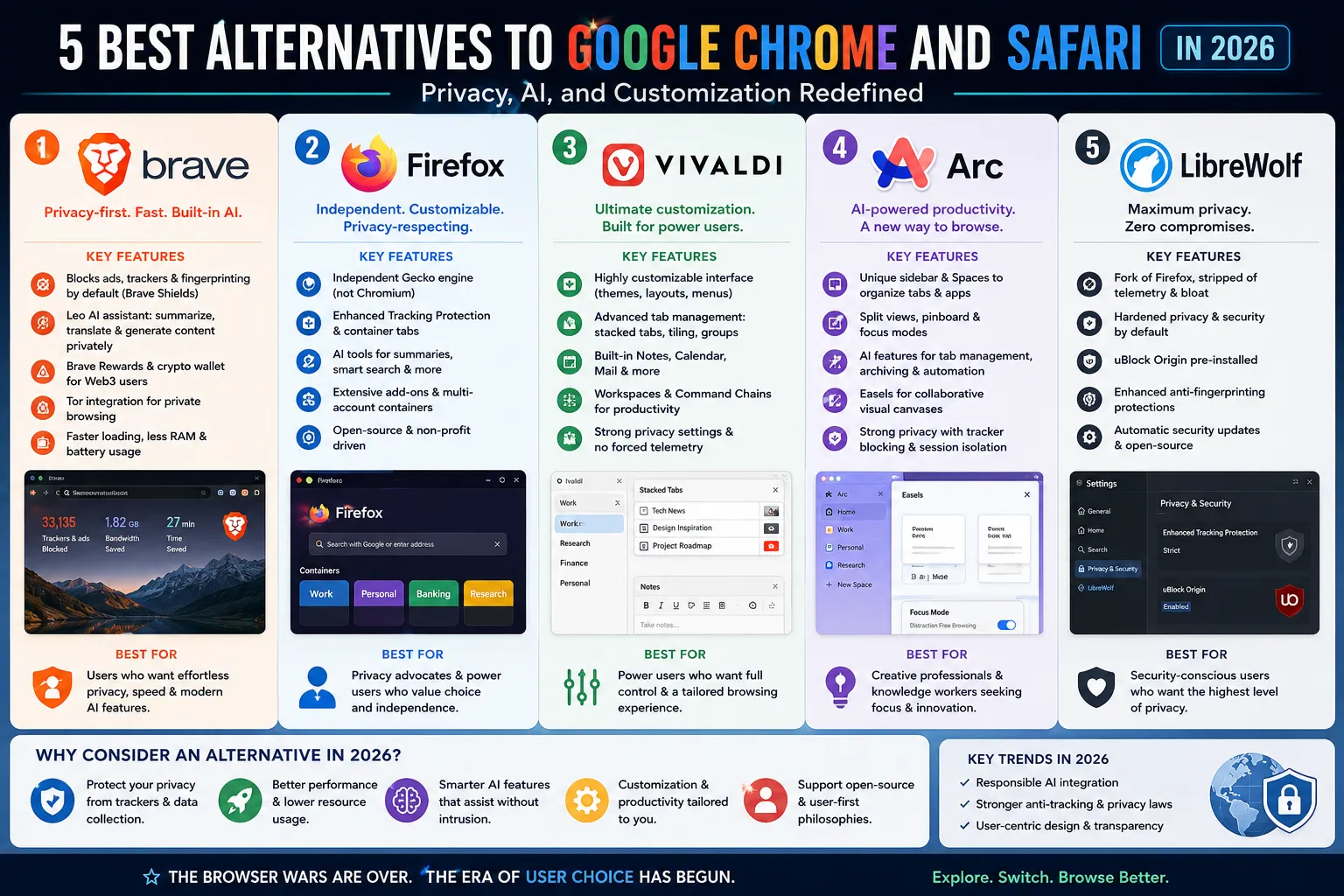
Brave stands out as a robust Chromium-based alternative that prioritizes user privacy without sacrificing speed or compatibility. It blocks ads, trackers, and fingerprinting by default through its Shields system, delivering faster page loads and reduced data usage compared to Chrome. Users appreciate its cryptocurrency rewards program (via Brave Rewards) and integrated wallet features for those interested in Web3.
In 2026, Brave’s Leo AI assistant provides on-page summarization, translation, and content generation with a strong emphasis on privacy—no login required for core functions. It supports Chrome extensions while offering Tor integration for private windows. Battery and RAM efficiency often surpass Chrome, making it ideal for everyday users seeking an “install-and-forget” solution that minimizes corporate surveillance. Brave appeals particularly to those transitioning from Chrome who want similar performance with superior out-of-the-box protections.
2. Mozilla Firefox: Independent Engine with Strong Privacy Tools
Firefox remains one of the few major browsers not based on Chromium, using Mozilla’s Gecko engine for true independence from Google-dominated standards. It excels in customization, container tabs for isolating site data, and enhanced tracking protection that goes beyond basic cookie management. Firefox’s focus on open-source principles and user rights makes it a favorite for privacy advocates.
Recent updates emphasize AI features responsibly, with tools for page summarization and smart search, while maintaining strict data policies. It performs well across platforms, including strong mobile versions, and consumes fewer resources than Chrome on many systems. Firefox’s extensive extension library and multi-account container support make it excellent for power users managing work, personal, and research profiles separately. For users wary of Big Tech ecosystems, Firefox offers a balanced, ethical alternative to both Chrome and Safari.
3. Vivaldi: Ultimate Customization for Power Users
Vivaldi redefines browsing with unparalleled personalization options, including stacked tabs, web panels, command chains, and highly customizable interfaces. Built on Chromium, it ensures broad compatibility while adding productivity tools like note-taking, calendars, and advanced tab management that Chrome and Safari lack natively.
Vivaldi’s philosophy centers on user empowerment rather than data extraction, with robust privacy settings and no forced telemetry. In 2026, it incorporates AI enhancements thoughtfully, focusing on workflow automation over intrusive assistants. Its ability to create “workspaces” and keyboard-driven navigation suits professionals juggling multiple projects. Users migrating from Safari appreciate the cross-platform consistency and from Chrome the escape from minimalism toward a feature-rich environment tailored to individual workflows.
4. Arc Browser: Innovative Interface with AI Productivity
Arc has gained traction as a modern, opinionated browser that transforms how users interact with the web. Its unique sidebar, spaces for organizing tabs and apps, split views, and focus-enhancing features create a more app-like experience. Originally Mac-centric, it has expanded with strong cross-platform support.
Arc integrates AI tools for intelligent tab management, page archiving, and workflow automation, making it ideal for knowledge workers. Privacy controls are solid, with easy session isolation and tracker blocking. Compared to Safari’s streamlined approach, Arc offers more dynamism; versus Chrome, it reduces clutter and boosts productivity. Its visual appeal and features like Easels for collaborative canvases position it as a creative alternative for users seeking an inspiring daily driver.
5. LibreWolf: Hardened Privacy Champion for Security-Conscious Users
For those prioritizing maximum privacy, LibreWolf—a fork of Firefox—strips out telemetry, Mozilla integrations, and potential tracking elements while retaining core performance. It ships with enhanced security defaults, including strict fingerprinting resistance, uBlock Origin pre-installed, and automatic updates for the latest protections.
LibreWolf avoids the bloat sometimes associated with mainstream browsers, delivering lean, fast browsing focused purely on user sovereignty. While it may require minor tweaks for certain sites, its uncompromising stance on data collection makes it superior for sensitive activities. In 2026, it serves as an excellent privacy baseline that can be further customized. Users disillusioned with Safari’s ecosystem ties or Chrome’s data practices find LibreWolf a reliable, no-compromise option that aligns with open-source values.
Choosing the Right Alternative: Key Considerations
When selecting among these browsers, consider your primary needs: Brave for seamless privacy and speed, Firefox for balanced independence, Vivaldi for deep customization, Arc for innovative productivity, and LibreWolf for hardened security. Most support cross-device syncing and extensions, easing the switch from Chrome or Safari. Test a few options, as personal preferences for interface and features vary widely.
Broader trends in 2026 show a shift toward AI integration done responsibly, stronger anti-tracking measures, and user-centric design amid regulatory pressures on data practices. These alternatives not only compete on features but also promote a healthier web ecosystem less dominated by a few tech giants.
Conclusion
Ditching Google Chrome or Apple Safari in 2026 opens doors to browsers that better respect privacy, harness AI meaningfully, and adapt to individual workflows. Whether you seek Brave’s effortless protections, Firefox’s principled foundation, Vivaldi’s flexibility, Arc’s creativity, or LibreWolf’s purity, superior options abound. Exploring these can lead to a more secure, efficient, and enjoyable online experience—proving that the browser wars are delivering real choices for users worldwide.
