
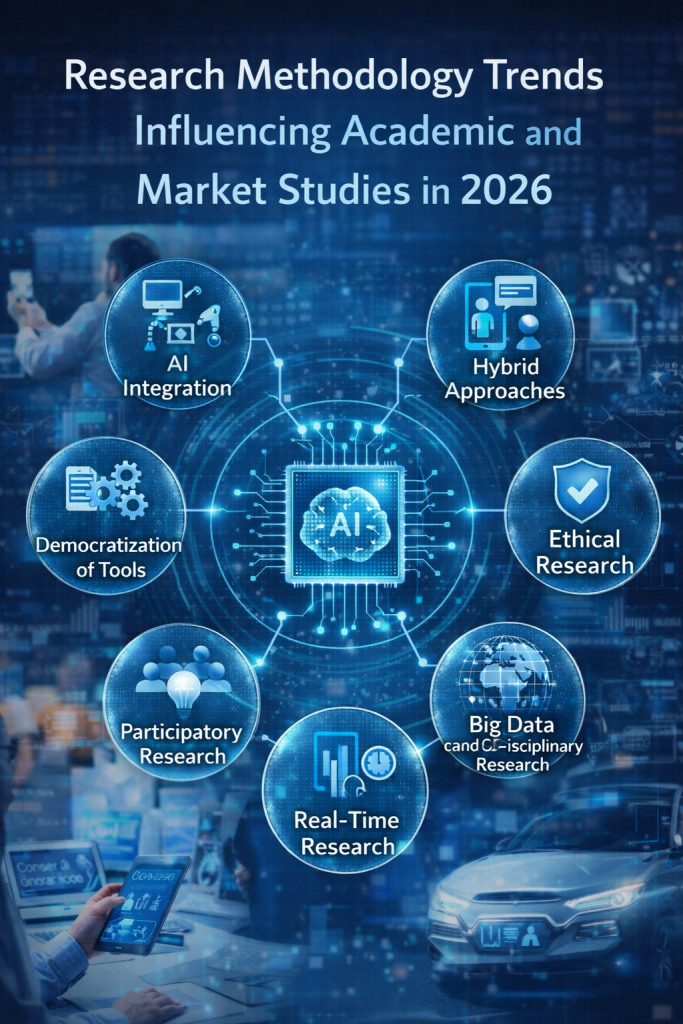
Research methodology has historically evolved alongside advances in technology, changes in academic paradigms, and shifting demands from industry and society. By 2026, the landscape of research—both academic and market-oriented—will continue to undergo profound transformation. New tools and methods are reshaping how data is collected, analyzed, interpreted, and applied. From artificial intelligence and real-time data analytics to participatory and hybrid research designs, modern methodologies are becoming more efficient, inclusive, and insightful.
These emerging trends reflect broader developments in data science, computational power, ethics, and collaborative research practices. Understanding them is essential for researchers, scholars, and businesses that seek to stay ahead in an increasingly data-driven world.
Table of Contents
ToggleAI Integration in Research Design and Analysis
Artificial intelligence (AI) is now integral to modern research workflows, influencing both academic and market studies. Machine learning algorithms and large language models (LLMs) are used to automate literature reviews, optimize survey questions, and perform complex data analysis. This integration allows researchers to process large datasets more efficiently than traditional methods.
In academic research, AI tools assist in identifying patterns and correlations that might be too complex or time-consuming for manual analysis. Similarly, market researchers use AI to generate real-time insights and predictive analytics, enabling faster decision-making. AI does not replace human judgment, but it significantly accelerates research cycles and expands analytical capabilities.
Real-Time and Continuous Research
Traditional research projects often follow fixed timelines, with data collected over months and then analyzed. In 2026, this model is giving way to continuous research that delivers real-time insights. This trend is particularly strong in market research, where rapid changes in consumer behavior require immediate analysis.
Always-on feedback loops and real-time dashboards allow researchers to monitor trends and respond quickly to new information. Rather than waiting for final reports, decision-makers can access live data streams that drive agile strategies. This model supports continuous learning and adaptation, making research more dynamic and relevant.
Hybrid Approaches: Blending Qualitative and Quantitative Methods
A major shift in research methodology is the increasing use of hybrid approaches that blend qualitative and quantitative techniques. While quantitative methods provide statistical power and precision, qualitative research adds depth, context, and meaning to the numbers.
By combining both approaches, researchers capture the “what” through numerical data and the “why” through human narratives and experiences. Hybrid methodologies are especially useful in social sciences, education, health research, and market studies where understanding human behavior is key. This integration strengthens the overall validity of findings and supports richer insights that are both actionable and nuanced.
Enhanced Data Collection Through Multi-Modal and Mobile Methods
The ways in which data are collected are evolving rapidly. Multi-modal data collection—incorporating text, video, audio, and sensor data—provides richer and more comprehensive datasets than traditional surveys or interviews alone. This trend is supported by virtual research platforms that capture responses through diverse formats.
Mobile-first research methods are also gaining traction. With high smartphone penetration globally, mobile surveys and mobile diaries allow researchers to reach participants more effectively and collect real-time behavioural data. These methods reduce traditional barriers to participation and help capture responses from previously hard-to-reach populations.
Participatory and Collaborative Research
Participatory research methodologies emphasize collaboration between researchers and stakeholders, including community members, end users, or clients. This approach ensures that research questions are relevant and grounded in lived experiences rather than abstract hypotheses alone.
In academic studies, participatory methods strengthen research validity by integrating stakeholder voices into design and interpretation. In market research, co-creation with customers helps organizations develop products and services that meet real-world needs. Participatory models reflect a broader trend toward democratizing research and valuing diverse perspectives.
Ethical Research and Data Privacy Considerations
With the rise of large-scale data collection and AI-assisted research, ethical considerations and data privacy have become central concerns. Researchers must now navigate stringent regulations and ethical protocols to ensure transparency, informed consent, and data protection.
Privacy by design, anonymization techniques, and robust governance frameworks help protect sensitive information. Ethical considerations also extend to algorithmic bias and fairness in AI-driven research. Ensuring that automated systems do not perpetuate or amplify bias is a major focus, especially in academic research involving human subjects.
Augmented Analytics and Predictive Modeling
Augmented analytics refers to the use of machine learning and natural language processing to automate data analysis tasks that traditionally required human expertise. This trend allows researchers to generate insights more efficiently and accurately.
In market research, augmented analytics helps translate raw data into actionable intelligence, while in academic studies it supports hypothesis testing and model building at scale. Predictive modeling using AI forecasts outcomes and uncovers trends that would be difficult to detect manually. These technologies enhance both speed and depth in research analysis.
Democratization of Research Tools
Another notable trend is the democratization of research tools—making advanced methodologies accessible to non-experts. Self-service analytics platforms, AI-assisted survey builders, and automated reporting tools empower individuals without deep technical skills to conduct credible research.
This democratization expands research capacity across industries and academic disciplines. Non-research specialists such as product managers, marketers, and educators can now generate insights independently, reducing reliance on specialized research teams while increasing organizational agility.
Virtual and Remote Research Environments
The rise of virtual qualitative research platforms has transformed how fieldwork is conducted. Researchers can now run remote interviews, focus groups, and lab sessions with global participants through virtual environments.
This shift not only broadens geographic reach but also enables flexible scheduling and multimodal data capture. However, it also requires researchers to be diligent about data quality, careful planning for analysis frameworks, and robust strategies for integrating diverse data types.
Integration of Big Data and Cross-Disciplinary Research
Big data continues to influence research methodology by enabling studies that incorporate massive datasets drawn from social media, IoT devices, and transactional systems. Combined with AI analysis, big data supports cross-disciplinary inquiries that link consumer behaviour, social trends, economic indicators, and scientific phenomena.
This trend enhances the scope of research capabilities, supporting studies that are broader in scale and deeper in insight. The convergence of big data with traditional methods yields a more holistic understanding of complex issues.
Conclusion
Research methodologies in 2026 reflect a balance between technological innovation, ethical responsibility, and methodological rigor. Artificial intelligence, real-time analytics, hybrid methods, and augmented tools are redefining how research is conducted across disciplines. At the same time, participatory research, ethical considerations, and democratized tools ensure that research remains inclusive, transparent, and impactful.
As academic and market research continue to evolve, these trends offer both opportunities and challenges. Researchers who embrace new technologies while maintaining rigorous design principles and ethical standards will be best positioned to generate meaningful, actionable insights in a rapidly changing world.
