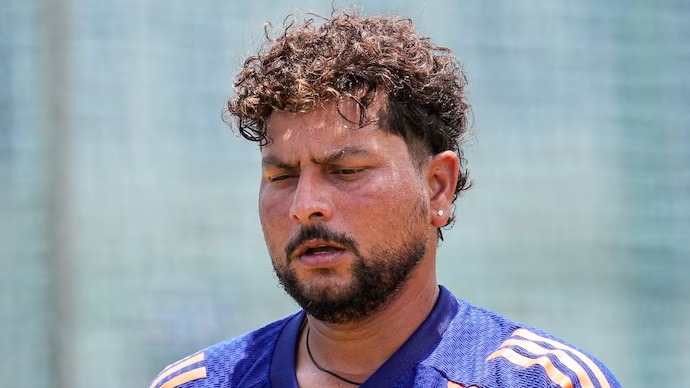

A Difficult First Test
Kuldeep Yadav entered the Sri Lanka Test series with plenty of expectations around his shoulders, especially after India had given him another opportunity in the longest format. His outing in Galle, however, was far quieter than many expected from the left-arm wrist-spinner. Kuldeep managed only one wicket from 25 overs across the two innings, while Ravindra Jadeja and Manav Suthar became the major forces with the ball.
The numbers do not exactly tell the entire story because Kuldeep was not given a huge workload during the match. He bowled 14 overs in the first innings and another 11 in the second innings, according to his match figures. Still, one wicket from those 25 overs means the performance did not create the impact India might have wanted from him.
Now the attention has shifted towards the second Test in Colombo, scheduled to begin on August 23. India won the opening Test by 165 runs, so the management has the luxury of considering whether the same combination should continue or whether conditions require a tactical change.
Why Colombo Creates Questions
The biggest issue for Kuldeep is not simply that he took one wicket in Galle. The larger concern comes from India’s changing spin combination and the emergence of another option in the squad.
Saransh Jain has been attracting attention around the team ahead of the Colombo Test, creating a selection discussion around the two spinners. Reports have suggested that the team could consider an off-spinner if the conditions appear more suitable for finger spin. However, the final playing XI had not been officially announced at the time of the latest reports.
That makes the situation interesting for Kuldeep because he does not have the same all-round batting value as Ravindra Jadeja. Jadeja can contribute heavily with both bat and ball, while Kuldeep’s biggest weapon remains his unusual wrist-spin variations.
India therefore has to judge what the pitch requires rather than simply selecting players based on reputation.
Kuldeep Still Has Support
Despite all the discussion, there is no clear indication that India has suddenly lost faith in Kuldeep Yadav. In fact, India’s spin bowling coach Sairaj Bahutule has publicly backed him after the Galle performance and described him as part of the team’s plans.
Bahutule explained that Kuldeep’s role in Galle was different because of the match situation and the behaviour of the Kookaburra ball. That explanation matters because a spinner’s impact cannot always be measured only through wickets, particularly when other bowlers are taking regular breakthroughs.
Head coach Gautam Gambhir has also offered support rather than criticism. His message to Kuldeep was straightforward, with the coach telling him to focus on bowling his best spell instead of becoming desperate for wickets.
That sounds like a small comment, but it tells us something about India’s thinking. The management does not appear interested in judging Kuldeep solely on one quiet performance.
The Pressure Comes From Competition
The difficult part for Kuldeep is that competition inside the squad has become more meaningful than before. India’s Test spin department has changed considerably after Ravichandran Ashwin’s retirement, while Jadeja is now an experienced senior player rather than a long-term solution for every future series.
Kuldeep has also spent much of his Test career moving between the playing XI and the bench. India Today noted that he had played only 18 Tests since his debut in 2017, highlighting the lack of continuity that has followed him for much of his career.
That history makes every selection decision feel bigger than one ordinary match. If he gets another opportunity in Colombo, he needs to show that his style can consistently create pressure in Test cricket.
At the same time, dropping him after one average outing could bring back the exact problem that has followed his career for years, which is a lack of continuity.
Galle Was Not Completely Negative
It would be unfair to describe Kuldeep’s Galle outing as a complete failure. He did take the important wicket of Kamindu Mendis during his opening spell in the first innings, showing that his variations could still trouble Sri Lankan batters.
The problem was maintaining that threat throughout the match. Jadeja and Manav Suthar were simply more productive, and Suthar’s performance became one of the biggest reasons behind India’s dominant victory.
Suthar’s success naturally makes the selection conversation more complicated. India now knows that another spinner can handle the conditions and contribute heavily, which gives the management more freedom when building the next XI.
That does not automatically make Kuldeep expendable, though.
Colombo Could Suit A Different Plan
The Colombo Test could bring a different tactical requirement, and that is where Kuldeep’s place becomes difficult to predict.
India’s stated priority is to select a bowling attack capable of taking 20 wickets. Gambhir made that point while discussing the second Test, although he also indicated that the final combination remains a captain’s decision.
If the Colombo surface offers assistance to finger spinners, India could lean towards a combination built around Jadeja and Suthar. If the pitch provides enough grip, bounce or variation, Kuldeep’s wrist-spin could again become valuable.
There is another factor that should not be ignored. A left-arm wrist-spinner offers a completely different angle compared with conventional off-spin. That variety can become useful when batters start becoming comfortable against one type of bowling.
The Bigger Kuldeep Yadav Question
The bigger question is not whether Kuldeep should be dropped after one quiet Test. It is whether India sees him as a genuine long-term Test match-winner.
That distinction matters.
If the management believes Kuldeep can become a major part of India’s Test future, then he needs opportunities where he can build rhythm and confidence. India has already lost one of its greatest Test spinners in Ashwin, while Jadeja’s career is moving into its later phase.
Kuldeep is therefore an unusual asset. His bowling style is rare, his variations are difficult to replicate, and his ability to attack from different angles can give India another dimension.
But those qualities become much more useful when he receives enough responsibility to influence a match.
One Quiet Test Should Not Decide Everything
Cricket selection is often driven by immediate results, but Test cricket requires a longer view. A spinner can bowl well without taking wickets, especially when the captain uses him in short spells or when another bowler is already dominating the opposition.
Kuldeep’s 25 overs in Galle were certainly quieter than expected, but India’s overall bowling attack worked extremely well. Jadeja and Suthar shared the bulk of the wickets, while India secured a comfortable 165-run victory.
The real danger for Kuldeep is therefore not one poor scorecard. It is the possibility that another spinner performs better while offering India a combination that management considers more balanced.
That is where the Colombo Test becomes important.
His Career Needs Continuity
Kuldeep’s Test career has repeatedly been interrupted by selection decisions, team combinations and the presence of established spinners. The current situation is slightly different because India’s Test side is entering another phase of transition.
The team needs new match-winners, but it also wants batting depth and reliable all-round options. That creates a difficult equation for a specialist spinner.
Former India spinner Murali Kartik has previously argued that constant movement in and out of the playing XI can affect a player’s confidence and preparation. His broader point is relevant here because Kuldeep has rarely received an uninterrupted Test run.
So, if India selects him for Colombo, the best approach may be to give him a clear role and enough overs to influence the game.
Colombo Selection Will Say Plenty
Whatever India decides before the second Test will reveal something about the team’s thinking. Keeping Kuldeep would suggest that the management values continuity and believes his Galle performance was only a temporary dip.
Leaving him out would not necessarily mean India has abandoned him. It could simply mean the pitch and team balance have pushed another option ahead of him for this particular match.
That distinction is important because Test cricket is full of tactical selections that do not always represent a permanent judgment on a player.
For Kuldeep, however, the timing makes the decision more significant. He has another chance to establish himself in India’s changing Test setup, but the competition around him is becoming stronger.
Final Take On Kuldeep’s Spot
Kuldeep Yadav’s quiet outing in Galle has certainly created a selection debate before India’s Colombo Test, but it would be too early to say that his Test place is in serious danger based on one match alone. He took one wicket from 25 overs, while Jadeja and Suthar produced the bigger bowling returns. Yet India’s coaching staff has continued to back him, and the management clearly understands the value of having a rare wrist-spinner available. Colombo will ultimately come down to pitch conditions, team balance and India’s need for 20 wickets. Kuldeep still has a strong case, but he now needs to turn that backing into a more influential performance.
Read More :- jayapokergacor.com