
Artificial Intelligence (AI) is no longer a futuristic concept confined to research laboratories or science fiction. It has become a foundational technology powering many of the devices, platforms, and services people use daily. From smartphones and voice assistants to healthcare systems and financial platforms, AI is transforming how technology functions and how individuals interact with it. By leveraging machine learning, natural language processing, computer vision, and data analytics, AI is making everyday technology smarter, faster, and more personalized.
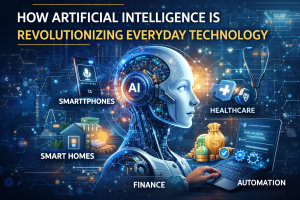
Below is a comprehensive look at how Artificial Intelligence is reshaping modern life, with detailed insights under each key area.
Table of Contents
Toggle1. AI in Smartphones and Personal Devices
Artificial Intelligence plays a central role in modern smartphones and personal gadgets. Features such as facial recognition, voice assistants, predictive text, and camera enhancements are powered by machine learning algorithms that improve with usage. AI enables devices to understand user behavior patterns, optimize battery usage, and enhance performance automatically.
For example, smartphone cameras use AI-based image processing to detect scenes, adjust lighting, and enhance photo quality in real time. Virtual assistants interpret voice commands through natural language processing, enabling hands-free control of apps and services. Predictive typing and smart replies save time by analyzing communication patterns. Over time, these systems adapt to individual preferences, offering a highly personalized experience that was not possible a decade ago.
2. Smart Homes and IoT Integration
Artificial Intelligence has transformed traditional homes into intelligent living spaces through smart home technology. AI integrates with Internet of Things (IoT) devices such as smart thermostats, security cameras, lighting systems, and home assistants to create automated environments.
Smart thermostats learn household routines and adjust temperatures automatically to improve comfort and energy efficiency. AI-powered security systems use facial recognition and motion detection to identify unusual activity and send alerts in real time. Voice-controlled assistants manage entertainment systems, appliances, and daily schedules through simple commands. The combination of AI and IoT allows devices to communicate with each other, creating seamless automation that improves convenience, safety, and sustainability in everyday life.
3. AI in Healthcare Technology
Healthcare has experienced one of the most significant impacts of Artificial Intelligence. AI systems assist doctors in diagnosing diseases, analyzing medical images, and predicting patient outcomes with high accuracy. Machine learning models process large datasets to detect patterns that may not be immediately visible to human professionals.
In medical imaging, AI helps identify early signs of conditions such as cancer, heart disease, and neurological disorders. Predictive analytics assists hospitals in managing patient flow and optimizing treatment plans. Wearable devices track heart rate, sleep patterns, and physical activity, using AI to provide personalized health insights. Telemedicine platforms use AI chatbots to assess symptoms and guide patients before they consult healthcare professionals. These innovations improve efficiency, reduce errors, and enhance patient care globally.
4. AI in Transportation and Mobility
Artificial Intelligence is revolutionizing transportation through advanced driver-assistance systems and autonomous vehicle technology. AI-powered systems analyze sensor data from cameras, radar, and lidar to make real-time driving decisions.
Modern vehicles use AI for lane-keeping assistance, adaptive cruise control, collision detection, and automated parking. Ride-sharing platforms rely on AI algorithms to match drivers with passengers efficiently and optimize routes based on traffic conditions. Predictive maintenance systems monitor vehicle performance and alert owners before mechanical issues escalate. In public transportation, AI enhances traffic management systems by analyzing congestion patterns and improving route planning. These advancements contribute to safer roads, reduced traffic congestion, and improved fuel efficiency.
5. AI in E-Commerce and Online Services
Artificial Intelligence significantly enhances user experience in e-commerce and digital platforms. Recommendation engines analyze browsing behavior, purchase history, and preferences to suggest products tailored to individual customers.
AI-driven chatbots provide instant customer support, handling queries and resolving issues around the clock. Fraud detection systems monitor transactions in real time to identify suspicious activities and prevent financial losses. Dynamic pricing algorithms adjust product prices based on demand, competition, and market trends. Personalized marketing campaigns use AI analytics to deliver targeted advertisements and content. These capabilities improve customer satisfaction while increasing operational efficiency for businesses.
6. AI in Education and Learning Platforms
Education technology has evolved rapidly with the integration of Artificial Intelligence. AI-powered platforms provide personalized learning experiences tailored to each student’s strengths, weaknesses, and pace.
Adaptive learning systems analyze performance data and adjust content difficulty accordingly. Intelligent tutoring systems offer real-time feedback and guidance similar to human instructors. Automated grading tools evaluate assignments quickly and consistently, saving educators valuable time. Language learning apps use AI to improve pronunciation accuracy and conversational skills. Additionally, predictive analytics help institutions identify students at risk of falling behind, enabling timely interventions. AI-driven education tools are making learning more accessible, interactive, and efficient worldwide.
7. AI in Financial Technology (FinTech)
Artificial Intelligence is a driving force behind innovation in the financial sector. Banks and financial institutions use AI algorithms for credit scoring, fraud detection, risk assessment, and customer service automation.
Machine learning models analyze transaction data to detect unusual patterns that may indicate fraud. Robo-advisors provide automated investment recommendations based on user goals and risk tolerance. AI chatbots assist customers with account inquiries, loan applications, and financial planning. Predictive analytics helps financial institutions evaluate creditworthiness more accurately. By automating complex processes and improving accuracy, AI enhances security, transparency, and efficiency in financial operations.
8. AI in Entertainment and Media
Entertainment platforms heavily rely on Artificial Intelligence to deliver personalized content experiences. Streaming services use recommendation systems to suggest movies, shows, and music based on viewing history and preferences.
AI algorithms analyze user engagement data to curate playlists and recommend trending content. In gaming, AI enhances realism through intelligent non-player characters and adaptive difficulty levels. Content creation tools use AI for video editing, animation, and even script generation. Social media platforms employ AI to filter content, detect harmful material, and tailor news feeds to individual users. These innovations reshape how audiences consume and interact with digital media daily.
9. AI and Workplace Productivity
Artificial Intelligence improves workplace productivity by automating repetitive tasks and enhancing decision-making processes. AI-powered software assists with scheduling, email filtering, data analysis, and document processing.
Robotic process automation (RPA) handles routine administrative work, allowing employees to focus on strategic tasks. Predictive analytics supports business forecasting and supply chain optimization. AI-driven collaboration tools transcribe meetings, summarize discussions, and organize project workflows efficiently. By streamlining operations and reducing manual effort, AI increases overall organizational performance and innovation capacity.
10. Ethical Considerations and Future Outlook
While Artificial Intelligence offers numerous benefits, it also raises important ethical and regulatory concerns. Issues related to data privacy, algorithmic bias, job displacement, and transparency require careful management. Governments and organizations worldwide are developing frameworks to ensure responsible AI deployment.
Looking ahead, AI is expected to become even more integrated into daily technology. Advances in machine learning, edge computing, and natural language understanding will enable more sophisticated applications. Human-AI collaboration will likely define the next phase of technological evolution, where intelligent systems augment human capabilities rather than replace them.
Conclusion
Artificial Intelligence is fundamentally transforming everyday technology across multiple sectors, including healthcare, transportation, education, finance, entertainment, and smart living. By enabling machines to learn from data and make intelligent decisions, AI enhances convenience, efficiency, personalization, and security.
As AI continues to evolve, its influence on daily life will only grow stronger. The key to maximizing its benefits lies in responsible development, ethical governance, and continuous innovation. Ultimately, Artificial Intelligence is not just changing technology—it is reshaping how society interacts with the digital world.
