
Article writing is an essential skill in academic, professional, and digital communication. Well-written articles help readers understand complex topics, gain new insights, and make informed decisions. However, many writers struggle to produce effective articles due to common mistakes that reduce clarity, quality, and credibility. These mistakes often occur because of poor planning, lack of research, or insufficient editing.
Understanding these common errors is the first step toward improving writing quality. When writers recognize where they go wrong, they can adopt better techniques to produce clear, engaging, and professional articles. Avoiding these mistakes not only improves readability but also increases the chances of reaching a wider audience. By focusing on proper structure, research, and language, writers can significantly enhance the overall effectiveness of their articles.
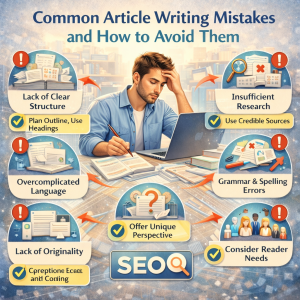
Lack of Clear Structure
One of the most frequent mistakes in article writing is the absence of a clear structure. Articles that are not organized properly can confuse readers and make it difficult to follow the main ideas. A well-structured article typically includes an introduction, body sections, and a conclusion that logically present the topic. Without this organization, readers may lose interest quickly.
To avoid this problem, writers should plan their article before starting. Creating an outline helps arrange ideas in a logical order and ensures that each section contributes to the overall message. Using headings and subheadings improves readability and allows readers to navigate the content easily. A clear structure helps communicate ideas effectively and keeps the article focused on its main purpose.
Insufficient Research and Information
Another common mistake is writing articles without adequate research. When writers rely only on personal opinions or limited information, the content may appear weak or unreliable. Readers expect articles to provide accurate and well-supported information, especially when discussing educational or professional topics.
To avoid this issue, writers should gather information from credible sources before writing. Careful research helps build a strong understanding of the topic and ensures that the content is informative and accurate. Including relevant facts, explanations, and examples strengthens the credibility of the article. Thorough research also helps writers present balanced perspectives and avoid misleading information.
Over complicated Language and Jargon
Many writers believe that using complex words and technical language makes their articles appear more professional. In reality, overly complicated language often makes the content difficult to understand. Readers may lose interest if they struggle to interpret the message of the article.
Effective writing focuses on clarity and simplicity. Writers should use straightforward language that communicates ideas clearly to the target audience. Avoiding unnecessary jargon and using simple sentence structures can make the article more accessible. When technical terms are necessary, they should be explained so that readers can understand them easily.
Poor Grammar and Spelling Errors
Grammar and spelling mistakes are among the most noticeable problems in article writing. Even a well-researched article can lose credibility if it contains frequent errors. These mistakes distract readers and create the impression that the content was not prepared carefully.
Writers can avoid this issue by proofreading their articles before publication. Reading the content multiple times helps identify grammatical mistakes, punctuation problems, and spelling errors. Many writers also benefit from using editing tools that highlight potential issues. Careful proofreading ensures that the final article appears polished and professional.
Lack of Originality
Originality is a critical element of effective article writing. Some writers unintentionally repeat ideas from other sources or produce content that lacks a unique perspective. Articles that do not offer new insights may fail to capture readers’ attention and can appear repetitive or uninteresting.
To avoid this problem, writers should focus on presenting ideas in their own words and offering fresh viewpoints. Combining research with personal analysis can make the content more engaging and valuable. Writers should also ensure that their work is free from plagiarism by properly rewriting information and adding their own interpretation of the topic.
Ignoring the Target Audience
Another mistake writers often make is failing to consider the needs and interests of their audience. Articles written without understanding the audience may use inappropriate language, irrelevant examples, or overly complex explanations. As a result, readers may find the content difficult to relate to or understand.
Successful writers always keep their audience in mind while creating content. Understanding who will read the article helps determine the tone, style, and level of detail required. For example, an academic audience may expect more detailed analysis, while general readers may prefer simpler explanations. Tailoring the article to the audience improves engagement and readability.
Weak or Missing Conclusion
A weak conclusion can reduce the impact of an otherwise well-written article. Some writers end their articles abruptly without summarizing the main points or reinforcing the key message. This can leave readers without a clear understanding of the article’s overall significance.
An effective conclusion should briefly summarize the main ideas discussed in the article and provide a final perspective on the topic. It should reinforce the key message and leave readers with a clear takeaway. A strong ending helps readers remember the important points and provides a sense of completeness to the article.
Conclusion
Article writing requires careful planning, research, and attention to detail. Many common mistakes—such as poor structure, insufficient research, complex language, grammar errors, lack of originality, ignoring the audience, and weak conclusions—can reduce the effectiveness of an article. By recognizing these challenges and adopting better writing practices, writers can significantly improve the quality of their work.
Avoiding these mistakes helps create articles that are clear, informative, and engaging for readers. Consistent practice, thorough editing, and a strong focus on audience needs can transform average writing into professional-quality content. Ultimately, mastering these skills enables writers to communicate ideas more effectively and build credibility with their audience.
