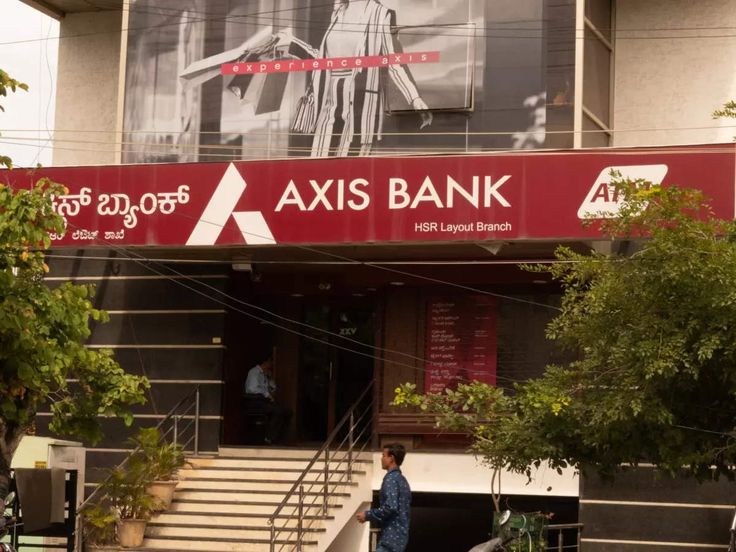

Axis Bank shares fell more than 4 per cent in Monday’s trading session even as the private sector lender reported a robust year-on-year rise in quarterly net profit. The stock reaction reflected market disappointment that earnings came in below consensus estimates, alongside concerns over sequential pressure on net interest margins and elevated operating costs. The decline made the bank one of the top losers on major indices, highlighting how investors weighed near-term margin and cost issues against longer-term positives such as strong loan growth and improving asset quality.
The lender reported a standalone net profit of Rs 7,003 crore for the second quarter of FY27, marking an increase of approximately 38 per cent from Rs 5,089 crore in the corresponding period of the previous year. On a consolidated basis, net profit rose around 39 per cent. While the absolute growth appeared healthy, the figure fell short of average market estimates that had clustered near Rs 7,124 crore to Rs 7,132 crore. The miss, though relatively modest in percentage terms, was sufficient to trigger selling pressure once markets opened.
Margin Compression and Cost Concerns Weigh on Sentiment
Net interest income, the difference between interest earned on loans and interest paid on deposits, rose 12 per cent year-on-year to Rs 15,371 crore and exceeded some analyst expectations. However, the net interest margin stood at 3.36 per cent for the quarter. This represented a sequential decline and remained below levels seen in the year-ago period. Management and analysts noted that heavy inflows of foreign currency non-resident bank deposits contributed to the margin pressure. Excluding the impact of these deposits, the margin was reported at a higher 3.47 per cent.
Operating expenses also drew attention. Elevated costs offset some of the benefits from lower provisions and solid core income growth. Operating profit increased 6 per cent year-on-year to Rs 11,083 crore, while core operating profit rose a stronger 11 per cent to Rs 10,998 crore. The combination of softer sequential margins and higher expense intensity led several market participants to describe the overall quarter as mixed rather than unequivocally strong.
Loan Growth and Asset Quality Provide Positive Counterbalance
On the balance-sheet side, the results contained clear positives. Advances grew 23 per cent year-on-year and 9 per cent quarter-on-quarter, indicating healthy demand for credit and continued market-share gains. Deposit growth remained supportive, helping fund the expansion in the loan book.
Asset quality continued to improve. The gross non-performing asset ratio declined to 1.16 per cent as of 30 September 2026, down from 1.28 per cent in the previous quarter and 1.46 per cent a year earlier. The net non-performing asset ratio improved to 0.35 per cent. Gross slippages moderated, and credit costs eased. Provisions and contingencies fell sharply by around 52 per cent year-on-year to Rs 1,694 crore, providing a significant boost to the bottom line. These trends suggested that the bank’s focus on cleaner underwriting and recoveries was yielding results.
Market Reaction and Brokerage Perspectives
The stock opened lower and extended losses during the day, with reports placing the decline in the 4 per cent range and the share price moving toward the Rs 1,230–1,240 zone at various points. Trading volumes were elevated as investors recalibrated positions following the numbers. The reaction underscored the market’s sensitivity to margin trajectories and expense trends even when headline profit growth remains robust.
Brokerage commentary after the results was generally constructive on the medium-term outlook, though some houses adjusted target prices to reflect the near-term headwinds. Strong loan growth, improving asset quality and the bank’s digital and retail franchise were frequently cited as supporting factors. At the same time, analysts flagged the need to monitor funding costs, the sustainability of margin recovery once the temporary impact of foreign currency deposits fades, and the trajectory of operating expenses.

Factors Investors Are Likely to Watch
Looking ahead, several elements will shape the stock’s performance. The pace at which net interest margins stabilise or recover will be closely tracked, particularly in a competitive deposit environment. The ability to maintain healthy loan growth without compromising asset quality remains central to the investment case. Operating leverage—whether revenue growth outpaces cost increases—will influence profitability metrics. Capital adequacy remains comfortable, providing room for continued balance-sheet expansion.
The broader banking sector environment, including interest-rate movements, credit demand across retail and corporate segments, and competitive intensity for deposits, will also influence outcomes. Axis Bank’s progress on digital initiatives, fee income diversification and risk management will continue to feature in assessments of its competitive positioning among large private lenders.
A Balanced View of the Quarter
The September quarter results present a nuanced picture. Profit growth was strong in absolute terms and supported by lower provisions and solid net interest income. Loan growth accelerated and asset quality ratios improved further. These are constructive signals for the franchise’s underlying health. At the same time, the sequential margin compression, the profit miss relative to expectations, and elevated operating costs explain the cautious market response.
For investors evaluating the stock, the key question centres on the durability of the positives versus the persistence of the near-term pressures. Strong credit growth and cleaner asset quality provide a foundation. Margin recovery and cost discipline will determine how quickly earnings momentum can re-accelerate. As with any banking stock, outcomes will depend on execution in the coming quarters and the evolving macroeconomic backdrop.
The sharp share-price reaction on results day reflects the market’s preference for clean beats and expanding margins. In this instance, the combination of a modest miss and sequential margin pressure proved sufficient to overshadow the solid year-on-year profit increase and balance-sheet progress. Subsequent quarters will offer clearer evidence of whether the margin headwinds prove temporary and whether operating leverage begins to assert itself more forcefully.
Read more – Lpainhand.com
