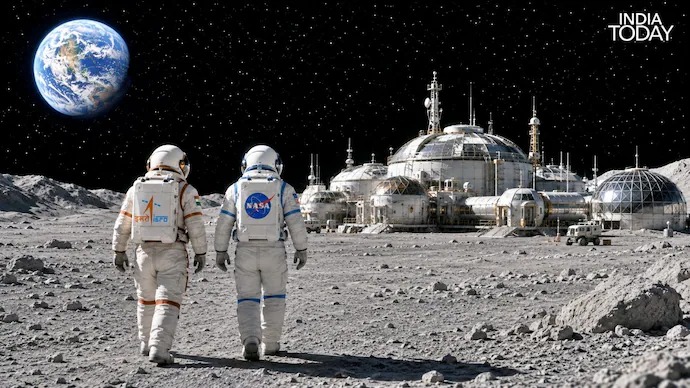
The Moon is no longer being viewed only as a distant scientific destination for space agencies around the world. NASA is increasingly looking at international partnerships, and India’s ISRO is becoming an important part of that bigger lunar strategy. The idea of building a sustainable Moon base sounds ambitious, but recent cooperation between the two agencies shows why India could have a meaningful role in that future.
Why ISRO Matters for Lunar Plans
ISRO has built a reputation for completing complex space missions while keeping costs comparatively controlled. That reputation has grown through missions involving lunar exploration, Mars, Earth observation, navigation, and commercial satellite launches. For NASA, such experience can become useful when lunar exploration moves from short visits toward longer operations.
India’s Chandrayaan missions have also demonstrated the country’s growing ability to work around the Moon and study its surface. Chandrayaan-3 achieved a historic soft landing near the lunar south polar region in 2023, giving India valuable experience in an area considered extremely challenging for future exploration.
The lunar south pole matters because scientists believe permanently shadowed regions there may contain water ice. That ice could eventually become a useful resource for astronauts, particularly if future missions can extract and process it efficiently.
A Moon Base Needs More Than Rockets
Building a Moon base will involve much more than simply landing astronauts on the lunar surface. Engineers will need reliable power systems, communication networks, navigation support, landing technologies, habitats, transportation equipment, and methods for protecting astronauts from radiation.
There will also be the everyday problem of supplying people living millions of kilometres away from Earth. Every kilogram transported from Earth comes with a significant cost, so future lunar missions will need to become increasingly efficient.
This is where ISRO’s cost-conscious engineering approach could become valuable. Lower mission costs do not automatically mean lower capability, and India has repeatedly demonstrated that carefully designed missions can achieve important scientific objectives without requiring extremely expensive systems.
NASA Brings Scale and Experience
NASA still has enormous advantages when it comes to large-scale space exploration. The agency has decades of experience with human spaceflight, deep-space science, robotic exploration, advanced propulsion, and complex international missions.
Through its Artemis programme, NASA is working toward returning astronauts to the Moon and developing a longer-term human presence there. The agency is also working with commercial companies and international partners to create the infrastructure required for sustained lunar exploration.
ISRO can potentially contribute within this larger ecosystem rather than attempting to build an independent lunar settlement alone. That distinction is important because a permanent lunar presence will probably require several nations and companies working together.
The Importance of Artemis Cooperation
India and the United States have already expanded their space cooperation considerably in recent years. The relationship now goes beyond basic scientific exchanges and includes discussions around human spaceflight, Earth observation, technology, and lunar exploration.
The NASA-ISRO collaboration is especially interesting because both countries have complementary strengths. NASA has substantial resources and long-standing human spaceflight expertise, while ISRO has developed strong capabilities in spacecraft engineering and relatively economical mission planning.
Future lunar projects could benefit from that combination. Instead of every country developing every system independently, international partners can divide responsibilities and build a larger exploration network.
Lunar South Pole Changes Everything
The Moon’s south polar region has become one of the most strategically important locations in modern lunar exploration. Unlike many familiar areas of the Moon, this region contains permanently shadowed craters where temperatures remain extremely low.
Scientists believe some of these locations may preserve water ice accumulated over extremely long periods. Water could become one of the most valuable resources available to future lunar explorers.
It could potentially provide drinking water after processing, support life-support systems, and even be separated into hydrogen and oxygen for propellant. That possibility makes the lunar south pole much more than an interesting scientific location.
India’s successful landing near this region gives ISRO experience that could become increasingly useful as international lunar programmes become more ambitious.
Cost Could Become a Major Advantage
Space exploration has always involved enormous financial pressure, especially when missions involve humans. A future Moon base will require repeated launches, cargo deliveries, replacement equipment, scientific payloads, and infrastructure construction.
The economics therefore become extremely important. If every mission costs too much, maintaining a lunar presence becomes difficult even for wealthy space agencies.
ISRO’s history of comparatively economical missions has attracted international attention for exactly this reason. India has shown that careful mission planning, domestic engineering, and controlled budgets can produce significant results.
That does not mean ISRO can simply build a cheap Moon base. Lunar construction remains incredibly complicated. Still, the agency could contribute technologies, spacecraft, scientific instruments, or mission capabilities that help reduce the overall burden.
Human Missions Will Raise The Stakes
Robotic spacecraft can tolerate conditions that humans cannot. A robot can spend years operating remotely without requiring oxygen, food, radiation protection, or a comfortable living environment.
Astronauts are different. Any human mission to the Moon must account for radiation exposure, extreme temperatures, dust, limited communication periods, medical emergencies, and psychological challenges.
A functioning Moon base therefore needs highly reliable systems. Even small failures could become serious when astronauts are hundreds of thousands of kilometres away from Earth.
International cooperation could provide additional redundancy. Multiple countries contributing different technologies may create a stronger lunar infrastructure than one agency attempting to handle every requirement alone.
India Wants a Larger Space Role
India’s space ambitions have also expanded rapidly. ISRO is working toward increasingly advanced human spaceflight capabilities through the Gaganyaan programme, while the country has expressed long-term ambitions involving a space station and eventually human lunar exploration.
Those goals fit naturally into the wider international push toward the Moon. Experience gained through human spaceflight can eventually support more complex missions beyond low Earth orbit.
For India, participation in major lunar programmes could also provide opportunities for scientists, engineers, startups, and private space companies. The benefits would extend beyond a single Moon mission.
Private Companies Will Matter Too
A future lunar base will probably not be built entirely by government agencies. Commercial space companies are already becoming major players in launch services, lunar landers, communications, robotics, and spacecraft development.
NASA has increasingly relied on commercial partners for parts of its lunar strategy. India is also encouraging private companies to play a larger role in the country’s space sector.
That combination could eventually create a complicated but powerful network. Governments could establish broad exploration goals while private companies develop specific hardware and services needed to make those goals practical.
What Could India Actually Contribute
ISRO’s future contribution could take several forms depending on how international lunar programmes develop. Lunar spacecraft, scientific instruments, communications equipment, navigation technologies, robotics, landing systems, and mission operations are all possible areas of cooperation.
India could also contribute scientific knowledge from its previous lunar missions. Data collected by Chandrayaan spacecraft can help researchers understand the Moon’s surface and environment.
The exact responsibilities would depend on formal agreements and technical requirements. It would be premature to assume that ISRO has been assigned a specific Moon-base construction role without an official project framework confirming those responsibilities.
A Bigger Future Beyond The Moon
The Moon is increasingly being treated as a testing ground for deeper space exploration. Technologies developed there could eventually support missions to Mars and other destinations.
A lunar base could help researchers learn how to live and work away from Earth for extended periods. It could also provide opportunities to test resource extraction, closed-loop life-support systems, autonomous robots, advanced habitats, and new transportation technologies.
That makes international cooperation even more important. No single country has unlimited resources, and deep-space exploration will require expertise from many different fields.
The Road Ahead Remains Difficult
Despite the excitement surrounding a possible Moon base, there is still a huge gap between plans and reality. Landing astronauts safely remains difficult, while constructing permanent infrastructure on the lunar surface presents engineering challenges that have never been solved at large scale.
Funding is another major question. Governments can announce ambitious programmes, but long-term lunar exploration requires sustained political and financial support.
There are also legal questions surrounding lunar resources, international responsibilities, communication infrastructure, and commercial activities. These issues will become more important as more nations and companies begin operating around the Moon.
A New Chapter for India and NASA
NASA and ISRO could eventually become important partners in creating a broader lunar exploration ecosystem. Their strengths are different, but that difference may actually make cooperation more useful.
For NASA, India offers growing technical capabilities, lunar experience, and a space programme that has demonstrated impressive efficiency. For India, cooperation with NASA can provide access to advanced technologies, international expertise, and participation in major human-spaceflight programmes.
The idea of a Moon base may still sound futuristic to many people. Yet the foundations for long-term lunar exploration are already being developed through missions, partnerships, commercial projects, and scientific research.
Conclusion: India Could Help Shape Lunar Exploration
The future of lunar exploration will depend on more than one successful landing or one powerful rocket. Building a sustainable Moon base will require reliable technology, international cooperation, careful spending, and years of persistent development. NASA has the scale and experience to lead major human exploration efforts, while ISRO brings valuable lunar experience and a strong record of cost-conscious engineering. If cooperation between the two agencies continues expanding, India could become an important contributor to humanity’s next major step beyond Earth. The Moon may become the beginning of a much larger journey.
Read More :- pixelperkes.com